

Picture this: a regional restaurant chain rolls out a new promotion at 9am. By noon, twelve of their fifteen locations are running it. The other three are still displaying last month's offer — one because the manager hasn't had time to print and swap the poster, another because the printed materials never arrived, and a third because nobody told that location the promotion existed at all.
Multiply that scenario across pricing updates, safety notices, brand campaigns, and daily specials, and you start to see the problem. This is what it means to have disconnected locations — and the cost is bigger than most businesses realize.
It's easy to write this off as a one-time hiccup — a training gap, a shipping delay, a busy manager who didn't get to it. But scale that scenario across a hundred locations, twelve months a year, and it stops looking like an occasional slip and starts looking like a structural problem. The locations aren't failing to execute; the system connecting them was never built to keep up with how fast a modern, multi-location business needs to move.
So what are companies with multiple locations supposed to do about it? That’s what we’re going to discuss today, as well as:
- What disconnection actually looks like inside a multi-location business
- The real cost of disconnected locations in terms of revenue, labor, and brand trust
- How digital signage closes that gap
- And the only digital signage platform your business needs!
What Does "Disconnected" Actually Mean?
Why it’s so easy for different locations to become disconnected

A disconnected location isn't necessarily one that's physically remote. It's a location that operates outside your real-time communication loop. Signs of disconnection show up in familiar, ways:
- Static menu boards or printed posters that can only be updated by physically replacing them
- Communication that relies on email chains, group texts, or PDFs that someone has to remember to check
- No single source of truth for pricing, promotions, or policy across locations
- Updates that depend on a regional manager driving between sites with a box of new signage
None of this is anyone's fault — it's simply what happens when a business scales faster than its communication infrastructure. A five-location business can get by on manual updates, group texts, and a shared folder of PDFs. A fifty-location business cannot, and the gap between "can get by" and "actively losing money" is where most companies are stuck right now.
The hard part is that disconnection is rarely diagnosed as the root cause. Leadership sees the symptoms — a slow promotional rollout, a customer complaint about pricing, a failed compliance audit — and treats each one as an isolated incident. Training gets updated. A new checklist gets circulated. But the underlying issue, a lack of real-time, centralized communication to every physical location, never actually gets fixed. It just resurfaces in a slightly different form next quarter.
The Real Cost of Disconnected Locations
The costs of disconnection rarely show up as a single line item. They're spread across labor hours, missed sales, brand damage, and risk — which is exactly why they're so easy to underestimate.
Lost Revenue & Missed Sales
Every hour a promotion isn't live is an hour of potential revenue missed out on. Disconnected locations are consistently slower to display new pricing, seasonal offers, and upsell prompts — and slower means fewer conversions. Worse, some locations may still be showing expired promotions, which creates pricing disputes at the register and erodes customer trust.
This isn't limited to marketing campaigns, either. Cross-sell and upsell prompts — the kind of in-the-moment nudges that drive a meaningful share of incremental revenue in retail and food service — depend entirely on the signage actually reflecting what's available, in stock, and relevant that day. A disconnected location is, in effect, leaving money on the table every single day it operates out of sync, not just during big campaign launches.
Wasted Labor & Operational Drag
Manual signage updates are expensive in ways that don't always appear on a budget report. Someone has to design the update, someone has to print it, someone has to ship or deliver it, and someone at the location has to physically install it — and that's assuming nothing goes wrong in transit. For a business with dozens of locations, that's a recurring labor and material cost that scales with every new site you open, rather than shrinking as you grow.
It also pulls people away from the work that actually matters at each location. A store manager taping up a new poster or reprogramming a menu board is a store manager who isn't on the floor helping customers or managing the team. Multiply that by every location, every update cycle, and the "invisible" labor cost of disconnected signage starts to rival the visible one.
Brand Inconsistency
Customers notice when one location feels like a completely different experience than another. Mismatched messaging, outdated visuals, and inconsistent promotions signal a lack of operational control — even if the products and service are identical. Brand consistency is one of the main reasons people trust multi-location businesses in the first place; disconnected locations erode that trust one visit at a time.
This matters even more for franchise organizations, where individual locations are independently owned but customers experience the brand as one unified entity. A franchisee running outdated signage doesn't just create a local inconsistency — they create a perception problem for every other location under the same name, even ones that are fully up to date.

Compliance & Safety Risks
In industries like healthcare, finance, and food service, signage isn't just marketing — it's regulatory. Expired safety notices, outdated compliance postings, or promotions that no longer meet current legal requirements create real exposure. When updates depend on someone physically noticing and replacing a sign, compliance becomes a matter of luck rather than process.
Slower Response to Change
Disconnected locations struggle to react to anything unplanned — a weather event, a local inventory shortage, a nearby community event, or an actual emergency. In these moments, minutes matter. A location that can't update its signage in real time is a location that can't communicate clearly when it matters most.
By the numbers, these costs compound quickly. A chain that spends even a few hours a week per location on manual signage updates, across dozens of sites, is looking at hundreds of labor hours a month — before accounting for printing, shipping, missed promotions, or a single compliance incident.
Why This Problem Is Growing
This isn't a one-time issue — it's an accelerating one. Multi-location businesses, franchises, and distributed retail footprints continue to expand, while corporate teams are often managing more locations with leaner on-site staff. At the same time, customer expectations have shifted. People expect real-time, personalized information whether they're ordering coffee, checking into a clinic, or walking into a bank branch. The businesses that can't keep pace with that expectation are the ones that feel disconnected — to customers and employees alike.
Remote and hybrid work has compounded the challenge further. Regional and district managers who once visited every location weekly may now oversee twice as many sites with half the in-person time. That means fewer eyes physically checking whether signage is current, fewer people catching a printing error before it reaches a customer, and more reliance on the location staff themselves to notice and fix problems on their own initiative. As footprints grow and oversight thins out, the cost of disconnection doesn't level off — it really adds up.
Why Digital Signage is the Solution to Disconnected Locations
Your company doesn’t have to just make due with the costs associated with disconnected locations, and digital signage could be the answer you’re looking for!

Centralized Content Management
Instead of designing, printing, and shipping materials to each location, digital signage lets you push content to every screen, at every location, from a single dashboard. One update, applied everywhere, instantly — no manual installation required. Whether you're managing five screens or five thousand, the workflow is the same: make the change once, and trust that it's live everywhere it needs to be.
Real-Time Responsiveness
Need to change a price, launch a promotion, or push an emergency alert? With digital signage, that update goes live in seconds rather than days. Locations stay in sync with HQ automatically, which eliminates the lag that causes missed sales and pricing disputes. This same responsiveness becomes critical during unplanned events — a severe weather warning, a product recall, or a local safety issue — where the ability to update every screen instantly can matter far more than any marketing use case.
Consistent Branding at Scale
Templates, brand guidelines, and permission controls ensure every screen reflects your brand correctly, whether you have five locations or five hundred. Local managers can still have flexibility where it's appropriate, without risking off-brand or outdated content going live.
Reduced Labor & Material Costs
Digital signage removes the ongoing cycle of designing, printing, shipping, and manually installing physical signage. That labor and material cost doesn't just shrink — it largely disappears, freeing staff time for higher-value work at each location.
Built-In Compliance & Accountability
Scheduled content, automatic expiration, and audit trails mean safety notices and compliance postings update on time, every time — without depending on someone remembering to swap a poster. That turns compliance from a manual task into a managed process.
Data-Driven Insights
Beyond solving the disconnection problem, digital signage gives you visibility you never had with static signage: what content is displaying where, how it's performing, and which locations may need attention. That data turns signage from a one-way broadcast into a feedback loop for the whole business.
Don’t Let Your Locations Become Disconnected: Use Shift to Keep Your Company Organized
There’s a clear choice for digital signage software designed to connect different locations
If you’re looking for a digital signage platform that can streamline operations, keep everyone in clear communication, and ensure consistency across locations, you turn to the experts at Shift. No company wants their locations to fall out of step with each other, and digital signs that can be updated across locations without the use of email is the way businesses can stay organized as they expand.
Shift makes it easy to set up your account on any TV screen. It’s designed to plug and play, so no IT department required! Use the content navigator to create content from scratch, or use one of their many templates to keep staff informed and customers aware of the most accurate information. But that’s not all. You can use Shift in a variety of ways, including:
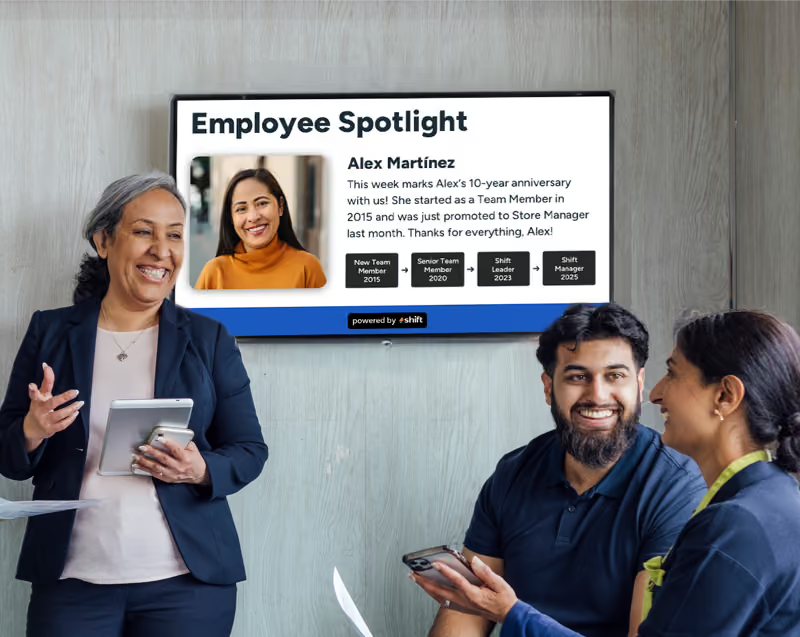
- Employee recognition through spotlights, work anniversaries, achievements, and birthdays
- Access to training materials
- Assisting with onboarding (for both employees and locations)
- Wayfinding
- Internal company communications without the need for email
- Posting safety or emergency alerts
- Surveys for staff through QR codes
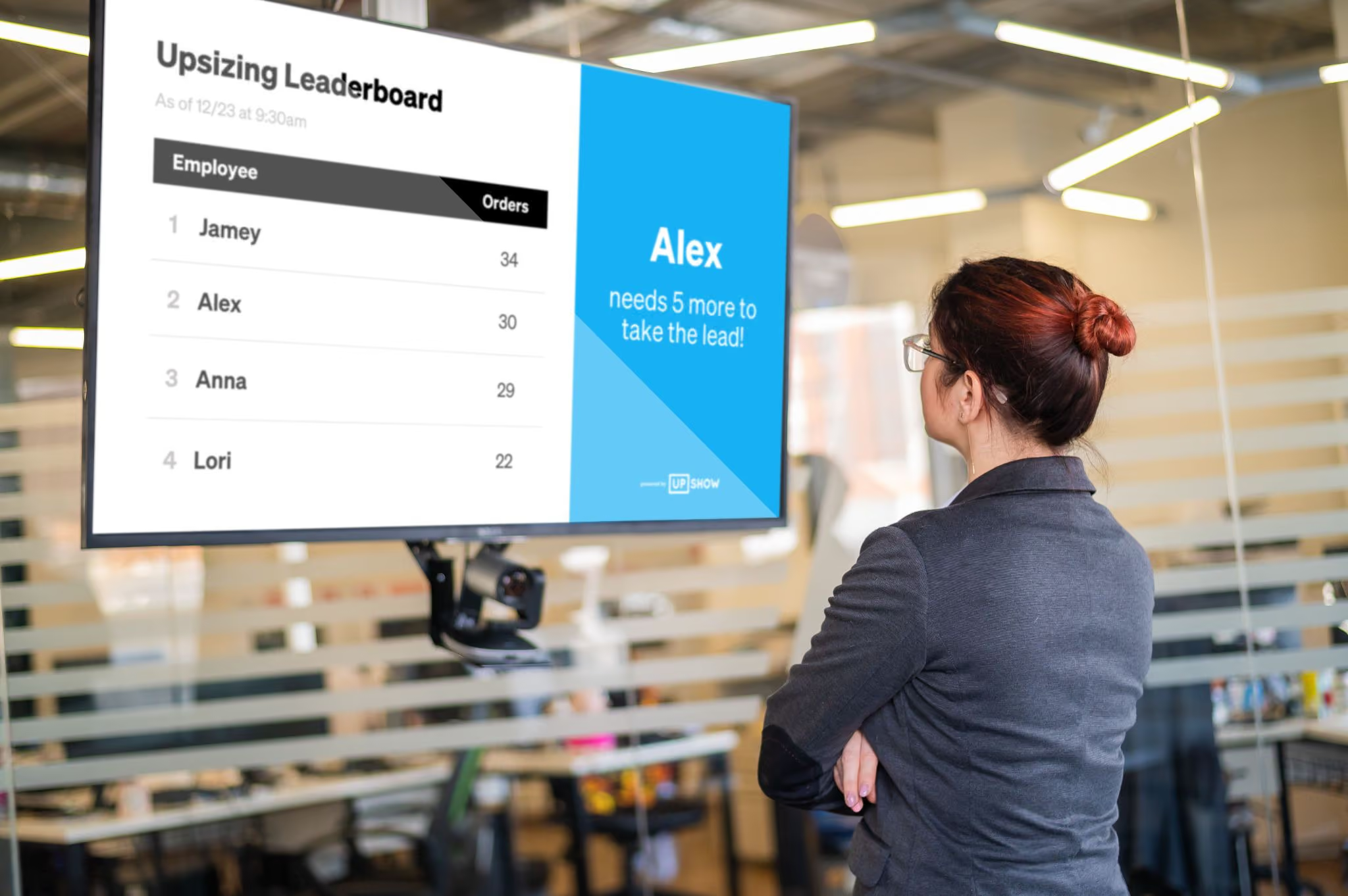
- Real-time leaderboards
Shift offers a 60 free trial, so you can really get a feel for how the software works before committing to purchasing. Digital signage from Shift can give businesses one centralized system to keep every location connected, on-brand, and responsive in real time.
Prevent Your Locations from Becoming Disconnected and Go with Shift!
The real cost of disconnected locations isn't always visible on a monthly statement, but it's there — in missed promotions, wasted labor hours, inconsistent branding, and compliance risk that grows with every new location you open. What looks like a minor operational inconvenience at five locations becomes a significant, recurring cost at fifty, and an unmanageable one well before you reach a hundred.
Digital signage isn't just a display upgrade. It's the infrastructure that reconnects your locations to a single source of truth — in real time, at scale, without the manual overhead.