
Manufacturing floors are some of the most dynamic — and highest-risk — workplaces in existence. Heavy machinery, forklifts and moving vehicles, rotating shift schedules, high employee turnover, and tight production deadlines all combine to make safety communication one of the toughest challenges a plant manager faces. A single missed message, an outdated procedure sign, or a hazard that goes unnoticed for even a few minutes can be the difference between a normal shift and a serious incident.
For decades, the default solution has been static signage: laminated posters bolted to the wall, hand-painted floor markings, and bulletin boards stuffed with outdated memos. The problem is that these tools were designed for a workplace that doesn't change much from week to week. That’s why manufacturers across the country are replacing static safety signs with connected digital displays that update instantly, grab attention far more effectively than a piece of paper, and can be centrally managed across dozens of facilities from a single dashboard.
In this article, we'll discuss the ins and outs of:
- Why digital signage is such a natural fit for manufacturing safety
- Examples of the safety content plants are using
- Best practices for rolling it out on your own floor
- The digital signage platform that can make improving safety easier than ever
The High Stakes of Safety Communication in Manufacturing
Why safety is absolutely essential in the manufacturing industry
Manufacturing consistently ranks among the industries with the highest rates of workplace injury, and machinery-related incidents like amputations, lacerations, and struck-by injuries remain persistent risks on production floors. Much of that risk isn't caused by a lack of rules — it's caused by a communication gap. Safety information exists somewhere (in a binder, on an intranet page, on a poster near the breakroom), but it isn't reaching the right people when they need it most.
This is especially true on floors that run multiple shifts, rely heavily on temporary or contract labor, and employ a workforce that speaks more than one language. A new hire on their first day, a contractor unfamiliar with a specific machine, or a third-shift worker who never sees daytime safety briefings are all examples of people who are more likely to be missed by traditional, static communication. Digital signage can solve this issue, making safety messaging consistent, visible, and repeatable — regardless of who's on the floor or when they clock in.
Why Digital Signage Is Perfect for the Manufacturing Industry
There are plenty of reasons why digital safety signage content is a must-have in manufacturing

1. Safety conditions change constantly — your signage should too
A spill, a malfunctioning machine, a temporarily blocked exit, or a shift change can all alter the risk profile of a facility within minutes. Printed signs simply can't react to that pace of change. Digital signage lets safety and operations teams push an update to every screen in the building — or across an entire network of plants — in a matter of seconds, ensuring the message on the wall always matches what's actually happening on the floor. There's no lag between "we know about the hazard" and "everyone on the floor knows about the hazard."
2. It commands attention in a noisy, visually busy environment
Manufacturing floors are loud, cluttered, and full of competing stimuli — machinery, moving equipment, and constant activity. A static printed sign fades into the background after the first week it's posted; most employees stop consciously seeing it entirely. Digital signage, by contrast, can use motion, bold color-coded alerts, and short video demonstrations to make safety messages genuinely difficult to tune out. Color-coded urgency levels (red for immediate hazards, yellow for caution, green for informational) are far easier to convey — and far more effective — on a bright, animated screen than on paper.
3. Centralized, remote content management
For manufacturers running more than one facility, digital signage means a single safety or communications manager can update messaging for every location from one content management system — no printing, shipping, or manually swapping out posters at each site. A new OSHA guideline, a product recall notice, or an updated lockout/tagout procedure can go live at every plant simultaneously. This type of consistency is nearly impossible to guarantee with printed materials distributed across multiple sites.
4. Real-time data integration
Modern digital signage platforms don't just display pre-scheduled content — they can pull live data directly from plant systems. Environmental sensors, machine uptime monitors, air quality sensors, and emergency alert systems can all feed directly into a screen. That means a display can automatically show a live gas leak warning, a temperature or humidity alert in a sensitive storage area, or an automatically updating "days since last incident" counter — all without anyone manually editing content. This turns signage from a static communication tool into an active part of the plant's safety infrastructure.
5. Built for a multilingual, multi-shift, high-turnover workforce
Manufacturing workforces are often multilingual, work around the clock in rotating shifts, and cycle through contractors, seasonal workers, and new hires at a higher rate than many other industries. Digital signage can automatically rotate safety messages in multiple languages, lean on universally recognizable icons and pictograms, and reach every single shift consistently — something a single static poster printed in one language simply cannot do. This is particularly valuable during onboarding, when new employees are absorbing an enormous amount of safety information in a short period of time.
6. Instant emergency communication
In the event of a fire, chemical spill, severe weather event, or active security threat, every second matters. Digital signage can be integrated directly with mass notification and building management systems to instantly override regular content with emergency instructions — evacuation routes, shelter-in-place directions, or muster point locations — across every screen in the facility at once. Compare that to a fire alarm and a printed evacuation map that may or may not still be accurate, and the advantage is even more obvious.
7. Measurable engagement and audit-ready documentation
Unlike a printed poster, a digital signage platform can log exactly what content played, on which screen, and at what time. That creates a documented trail safety managers can use to support compliance audits, demonstrate that specific safety messages were actively communicated, and identify whether training content is actually reaching employees on the floor. When OSHA or an internal auditor asks "how do you know your team saw this," a digital signage log is a far stronger answer than "we posted it in the breakroom."
8. Lower long-term cost and less waste
There's an upfront investment in screens, mounts, and a digital signage CMS to run it, but digital signage eliminates the recurring cost of printing, laminating, and physically replacing signage every time a regulation, layout, or piece of equipment changes. Over the life of a facility, that adds up — both in dollars saved and in the paper waste avoided by not reprinting posters every time something shifts on the floor.

9. Reinforces a proactive safety culture
Beyond compliance, visible and constantly updated safety signage sends a message to employees: safety is an active, ongoing priority, not a box that was checked once during a plant's initial build-out. Screens showing live safety metrics, recognition for safe behavior, or recent "lessons learned" from near-misses help build a culture where safety feels present and current, rather than something relegated to a dusty binder in the break room.
What Are Some Examples of Safety Signage?
There are plenty of ways managers can harness the power of digital signage to put out safety information
Digital safety signage can display a wide range of content, often rotating through a playlist so multiple message types are reinforced throughout the day, or triggered automatically by sensors, schedules, or integrations. Common examples include:
- Hazard and warning alerts — Real-time notices about wet floors, active forklift traffic, high-voltage areas, or machinery that's currently down for maintenance.
- PPE reminders — Visual reminders to wear hard hats, safety glasses, hearing protection, gloves, or steel-toed boots in designated zones, sometimes triggered automatically as employees enter specific areas via sensors or badge readers.
- Emergency evacuation routes and maps — Clear, illuminated maps showing the nearest exits, muster points, and fire extinguisher or AED locations, which can automatically switch to a dedicated emergency layout the moment an alarm is triggered.
- Lockout/Tagout (LOTO) procedures — Step-by-step visual instructions for safely de-energizing specific equipment before maintenance or repair work begins, reducing the risk of a technician skipping a step from memory.
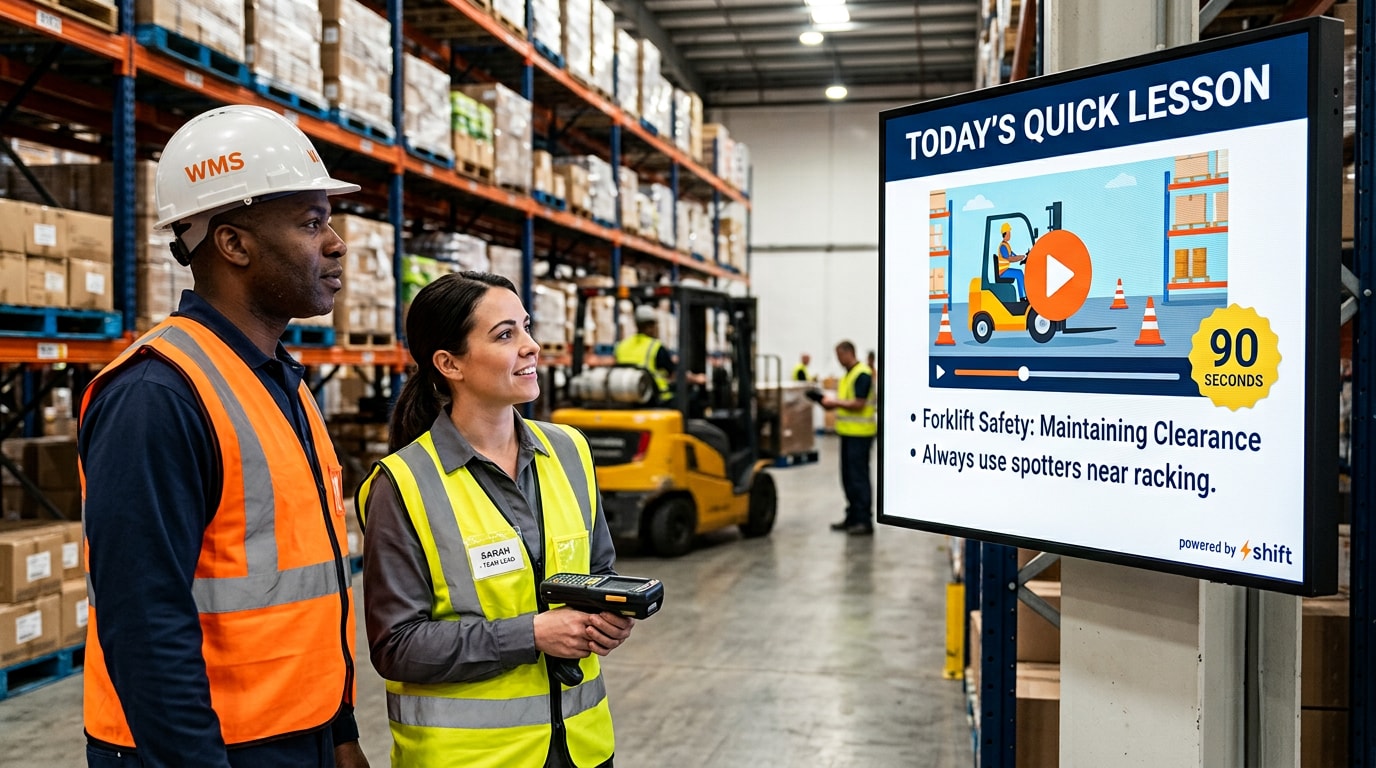
- Machine-specific safety instructions — Screens mounted near individual equipment showing correct operating procedures, pinch-point warnings, or short safe-use demonstration videos relevant to that exact machine.
- Live safety metrics and dashboards — "Days since last incident" counters, current safety scorecards by department, or other KPIs that reinforce accountability and give teams a shared, visible goal.
- Weather and environmental alerts — Live feeds for severe weather warnings, air quality readings, or temperature and humidity data in sensitive storage or production areas.
- Chemical and hazardous materials information — Safety Data Sheet (SDS) access points and hazard classification signage, including GHS pictograms, posted near chemical storage and handling areas.
- Traffic and pedestrian safety signage — Digital, sensor-triggered signage directing pedestrian walkways and forklift or vehicle traffic patterns, especially at blind corners or high-traffic intersections.
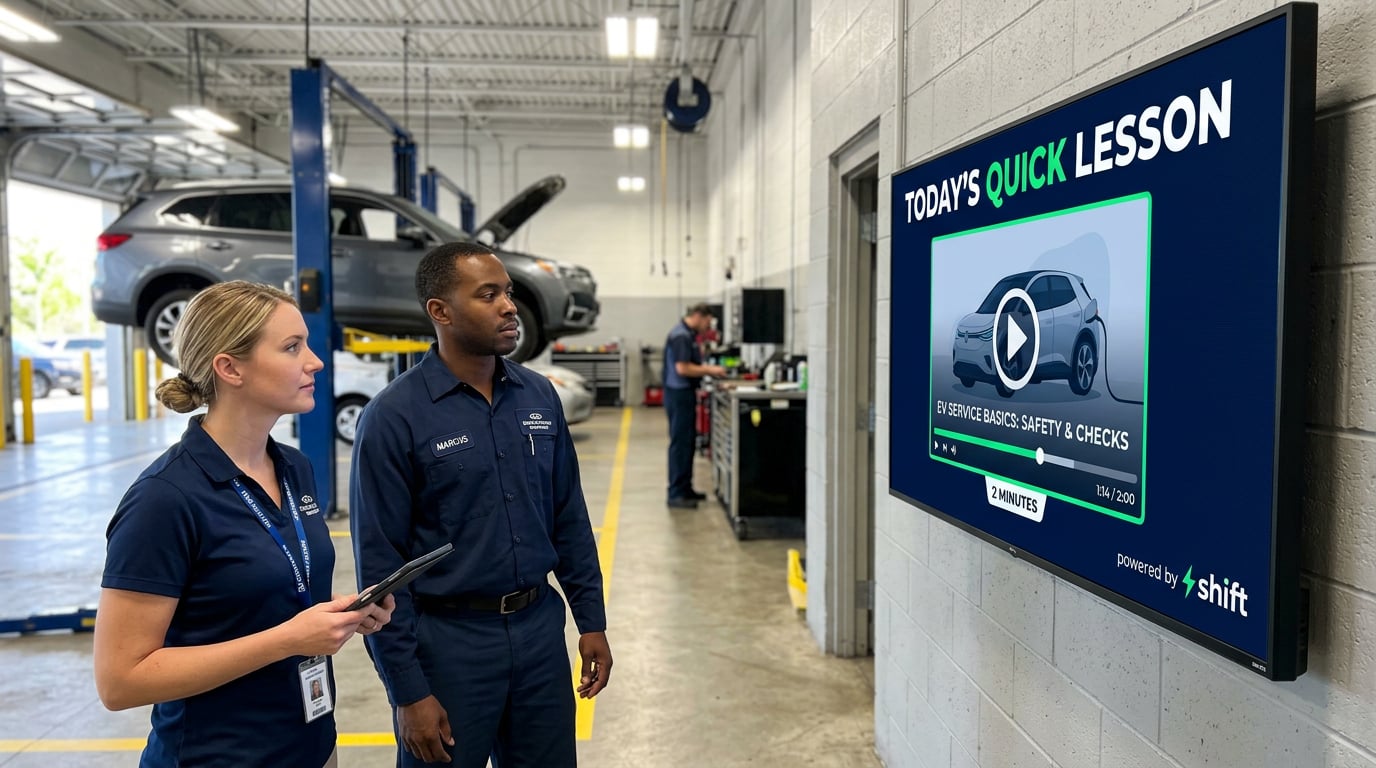
- Training and onboarding content — Short looping videos or slides reinforcing recent training topics, new-hire safety orientation material, or refresher content tied to a recent near-miss or incident.
- Shift-specific announcements — Safety briefings, toolbox talk topics, or incident recaps relevant to the upcoming shift, ensuring second- and third-shift employees get the same information as the first shift.
- Emergency contact and reporting information — Clearly displayed instructions for reporting hazards, injuries, or near-misses, along with emergency contact numbers, safety hotline information, and the nearest first aid station.
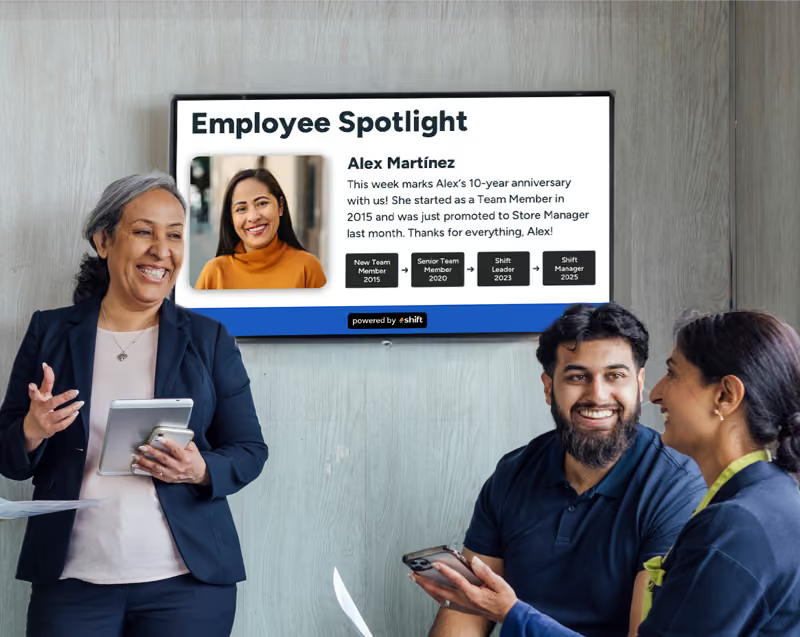
- Recognition and behavior reinforcement — Highlighting departments or individuals with strong safety records, or celebrating milestones like incident-free periods, to reinforce positive behavior alongside warnings and instructions.
Best Practices for Rolling Out Safety Signage on the Manufacturing Floor

Getting the most out of digital signage isn't just about hanging screens — it's about how the content and hardware are planned. A few things to consider:
- Place screens where decisions actually happen. A PPE reminder is most effective right at the entrance to a zone that requires it, not tucked away in a hallway no one walks through.
- Prioritize legibility over cleverness. High-contrast colors, large text, and simple icons read faster than dense paragraphs, especially from a distance or in a moving vehicle.
- Integrate with existing systems where possible. The more a display can pull automatically from sensors, alarms, or safety management software, the less manual upkeep it requires — and the more reliably it reflects real conditions.
- Build in redundancy for emergencies. Emergency content should be able to override regular programming immediately, without requiring someone to manually navigate a content library mid-crisis.
- Review and refresh content regularly. Even digital content can go stale if it's left running unchanged for months. Treat your signage playlist the way you'd treat a training curriculum — revisit it on a schedule.
Use Shift for All Your Digital Signage Safety Content in the Manufacturing Industry
If you want a digital signage platform that makes it easy to create safety content that actually gets seen and remembered, go with Shift. Shift’s content navigator and included templates makes it simple to get safety warnings and instructions onto your manufacturing floor ASAP. The plug and go design means it’s a breeze to set up, and you can change and update information from any device in real time. Shift can deliver real-time updates to the floor for safety concerns, whenever you need them. In addition, you can also utilize screens to include:
- Employee recognition through spotlights, work anniversaries, achievements, and birthdays
- Access to training materials and quick refreshers
- Assisting with onboarding
- Wayfinding throughout the warehouse or manufacturing floor
- Internal company communications specifically for your workforce
- Posting safety or emergency alerts
- Surveys for staff through QR codes
- Real-time information like production and performance KPIs
In the manufacturing industry the cost of a missed safety message can be measured in injuries, downtime, and compliance risk, digital signage isn't just a nice upgrade over the laminated poster — it's quickly becoming a foundational part of how modern manufacturing facilities keep their people safe.