.avif)
Organizations today are placing greater emphasis on workplace experience — recognizing that the physical environment directly affects employee satisfaction, retention, and productivity. How a space feels to navigate is part of that experience. A confusing, frustrating layout signals disorganization. A smart, responsive wayfinding system signals investment in the people who use the space.
For visitors and clients, the stakes are even higher. First impressions carry enormous weight, and the experience of arriving at a facility — how welcomed, informed, and guided a visitor feels — shapes their perception of the entire organization.
Digital wayfinding signage sits at the intersection of all of these forces, which is why we’ll be covering:
- How digital wayfinding signage works
- The benefits of digital signage for employees, guests, and visitors
- Why wayfinding is effective in a variety of environments
- The digital signage software you need to start making it easier to navigate your space
Understanding Digital Wayfinding Signage
The ins and outs of why this particular form of digital signage is so helpful
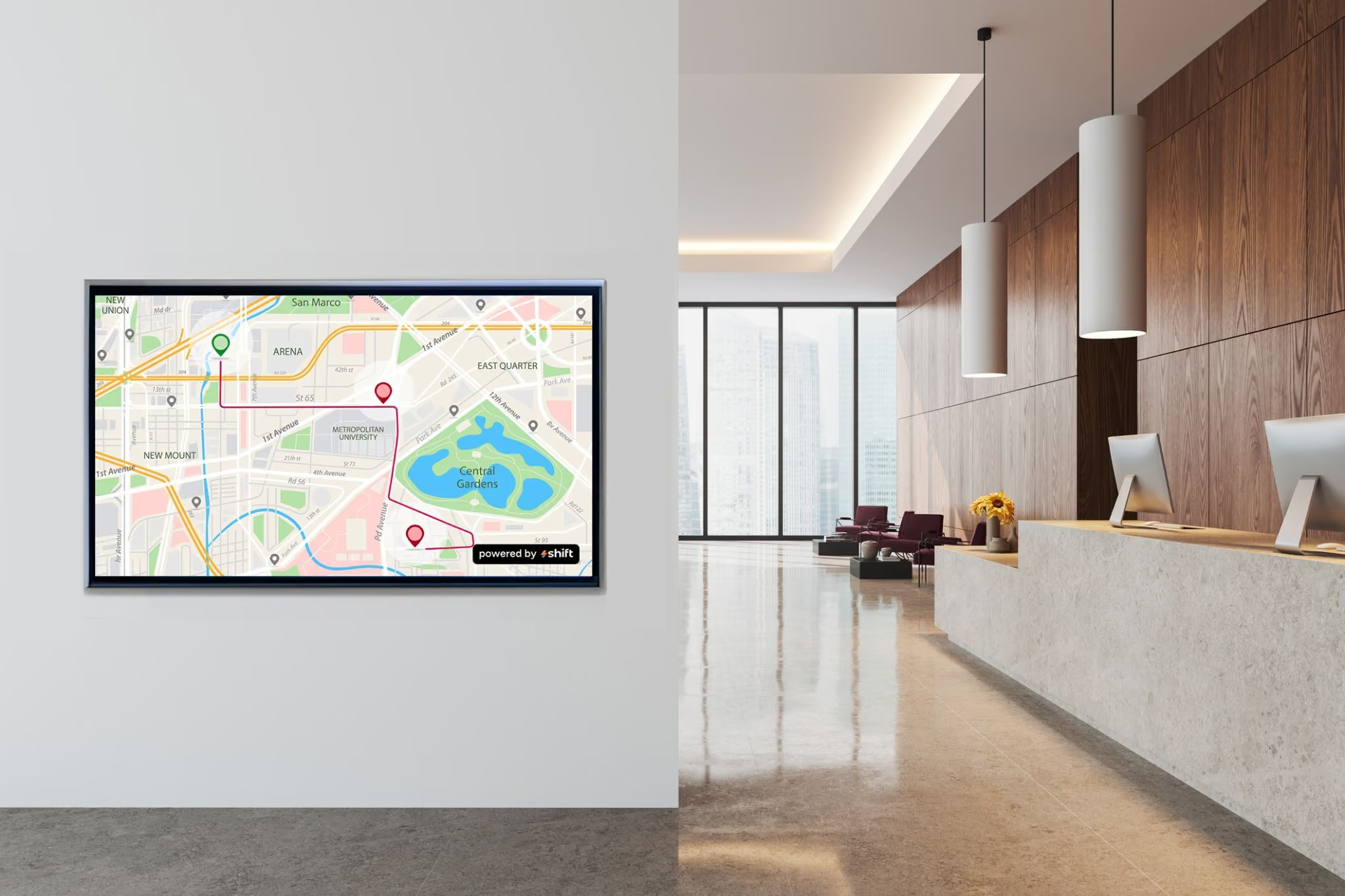
For anyone stepping into a new environment — whether for the first time or the hundredth — finding the right place at the right time can be genuinely stressful.
Digital wayfinding signage is an interactive, technology-driven navigation system designed to guide people through physical spaces with clarity and ease. Unlike traditional static signs — fixed plaques, printed floor maps, or paper directories — digital wayfinding systems are dynamic, updatable, and responsive to the user's needs in real time.
At their core, these systems typically include:
- Interactive display kiosks placed at key entry and decision points throughout a facility
- Touchscreen maps that allow users to search for a destination and receive step-by-step directions
- Integration with live data such as room bookings, employee directories, and event schedules
- Mobile connectivity through QR codes or companion apps, so directions travel with the user
Some systems go further, incorporating voice interaction, multilingual support, accessibility features, and even integration with smart building infrastructure. The result is a seamless, intuitive navigation experience that meets users where they are — whether they're a first-time guest or a longtime employee adjusting to a newly reorganized floor plan.
To appreciate what digital wayfinding offers, it helps to understand the limitations of the systems it replaces.
Traditional static signage — printed directories, engraved plaques, painted wall maps, and overhead hanging signs — served organizations reasonably well for decades. But it was designed for a different era: one where office layouts rarely changed, staff rosters were stable, and visitors were few and predictable.
The core limitation of static signage is that it is fixed at the moment of its creation. The moment a department moves, an employee changes roles, a room gets repurposed, or a new wing opens, static signage begins to mislead rather than guide. Updating it requires physical reprinting, rehanging, and often significant expense — which means many organizations simply don't update it promptly, leaving outdated and contradictory information in place.
Digital wayfinding solves this at the root. Changes made in the system's CMS propagate instantly to every display in the network. A room renamed on Monday morning shows its new name on every kiosk by Monday morning. A visiting executive's temporary office is findable from the moment it's assigned. A floor closed for renovation can be flagged and rerouted system-wide with a few clicks.
Using a digital solution to wayfinding means no more static solutions, instead it can be easily integrated into your digital signage content.
The Benefits of Digital Wayfinding Signage
There are all kinds of ways digital wayfinding signage benefits both employees and visitors
For employees, the benefits extend well beyond simply knowing how to get from point A to point B. A well-implemented system reshapes how people experience their workplace — reducing stress and saving time.
For employees
The most immediate and quantifiable benefit of digital wayfinding for employees is time saved. In a large or complex facility, the minutes spent searching for a meeting room, locating a colleague's desk, or finding a specific department accumulate into a meaningful productivity drain over the course of a week.
Consider a mid-sized corporate campus with several buildings, multiple floors, and hundreds of employees operating on a hybrid schedule. On any given day, staff may need to navigate to a conference room they've never used, find a colleague who is hot-desking in an unfamiliar area, or locate a facility — a printer, a break room, a first aid station — in a part of the building they rarely visit. Without reliable navigation support, each of these small tasks requires effort: asking a colleague, checking an email for a room number, or wandering until something looks familiar.
Digital wayfinding eliminates that effort. An employee can walk up to a kiosk or consult their phone, type in a destination, and receive a precise, optimized route in seconds. Multiply those seconds saved across hundreds of employees and dozens of daily navigation events, and the cumulative productivity gain becomes substantial.
For organizations with large campuses — technology companies, university medical centers, government facilities — this benefit is even more pronounced. Research consistently shows that unplanned interruptions and navigation-related delays are among the most commonly cited sources of workplace inefficiency. A system that eliminates those delays pays for itself in recovered time alone.
Supporting New Employee Onboarding
Starting a new job is cognitively demanding. New hires are simultaneously absorbing company culture, learning processes, meeting colleagues, and navigating an unfamiliar physical environment — all at once. The layout of a building may seem like a minor concern in that context, but spatial disorientation adds a layer of stress that compounds the challenge of an already overwhelming first few weeks.
Digital wayfinding signage serves as a silent, always-available guide during the onboarding period. Rather than relying on a buddy or a printed map that may be out of date, new employees can independently find HR, IT, the cafeteria, their manager's office, or the nearest restroom without having to ask anyone. That independence — small as it may seem — contributes meaningfully to a new hire's sense of confidence and belonging.
Emergency Guidance and Safety Navigation
Wayfinding is not only about convenience — it is also a critical component of workplace safety. In an emergency, the ability of employees to quickly locate exits, evacuation routes, assembly points, fire extinguishers, defibrillators, and first aid stations can make a meaningful difference in outcomes.
Traditional emergency signage — static exit signs and printed evacuation maps — provides a fixed, generic guidance layer that does not account for the specifics of a given emergency. A fire blocking the nearest exit, a corridor under renovation, or an evacuation route that has changed since the signs were last updated can render that guidance incomplete or misleading at the worst possible moment.
Real-Time Adaptation to Dynamic Workplace Layouts
The traditional office — where every employee had an assigned desk, every department occupied a fixed floor, and the layout changed only during major renovations — is increasingly a relic of the past. Today's workplaces are fluid. Hot-desking, activity-based working, team pods, flexible meeting spaces, and constantly shifting project configurations mean that the physical landscape of an office can look meaningfully different from one week to the next.
Static signage is structurally incapable of keeping pace with this level of change. A department that moved last month may still be pointing visitors and colleagues to the wrong floor. A newly designated quiet zone may not appear on any map. A bank of desks that was assigned to one team last quarter may now serve a different group entirely.
For visitors
The benefits for visitors and guests are distinct from those for employees, though they are equally significant. Where employees benefit primarily from efficiency and consistency over time, visitors benefit most from clarity, confidence, and the quality of first impression.
Creating a Positive and Lasting First Impression
First impressions are formed quickly — research in environmental psychology suggests that people assess a new space within the first few seconds of entering it. In those initial moments, visitors are taking in everything: the cleanliness of the lobby, the professionalism of the reception area, the ambient noise level, and — critically — the clarity of the signals telling them where to go and what to do next.
A digital wayfinding kiosk positioned prominently at a building entrance communicates several things simultaneously and immediately. It signals that the organization is modern and technology-forward. It demonstrates that the organization anticipated the visitor's needs before they arrived. It shows investment in the quality of the visitor experience. And it provides immediate, practical relief from the anxiety of being in an unfamiliar space — which generates goodwill before a single human interaction has taken place.
Enabling Self-Service Navigation
One of the most practically valuable benefits digital wayfinding delivers to visitors is the ability to navigate independently — without needing to ask anyone for help, wait for an escort, or rely on directions that may be incomplete or misremembered.
This matters for several reasons. Visitors often arrive at facilities at unpredictable times — early for a meeting, after hours for an event, during a moment when reception staff are occupied or unavailable. In these situations, a self-service wayfinding kiosk is not merely convenient; it is the difference between a visitor finding their destination and a visitor becoming stranded in a lobby or wandering into restricted areas.
Why Wayfinding Signage is So Effective
Going digital for wayfinding is one of the best decisions your company can make

Not all digital wayfinding systems are created equal. The difference between a system that genuinely transforms how people navigate a space and one that becomes an expensive, underused piece of lobby furniture often comes down to the depth and quality of its features.
Effective wayfinding digital signage needs to have a few qualities to truly make them effective.
Interactive Touchscreen Maps with Search Functionality
The interactive map is the heart of any digital wayfinding system, and its quality determines more than any other single feature whether users find the system genuinely useful or merely decorative.
At a minimum, an effective interactive map must be accurate, current, and visually clear. Floor plans should be rendered at a level of detail that is informative without being overwhelming — showing rooms, corridors, amenities, and key landmarks in a way that allows users to quickly orient themselves and understand the layout of the space.
Integration with Room Booking and Calendar Systems
A wayfinding system that displays static room information is useful. A wayfinding system that displays live room availability, current bookings, and real-time occupancy data is transformative. The difference is integration — specifically, the connection between the wayfinding platform and the organization's room booking and calendar infrastructure.
Live Data Feeds: Occupancy, Wait Times, and Event Schedules
The value of a digital wayfinding display is not limited to navigation. Because these displays are networked, dynamic, and strategically positioned at high-traffic points throughout a facility, they represent a powerful communication channel — one that can deliver relevant, real-time information to users at exactly the moment and location where it is most useful.
Branding, Customization, and White-Label Options
A wayfinding system deployed in a carefully designed facility should feel like a natural, intentional part of that environment — not a generic technology product installed by a vendor. The ability to customize the visual design, content, and personality of wayfinding displays is therefore not merely an aesthetic preference; it is a fundamental requirement for organizations that take their brand and visitor experience seriously.
Digital Wayfinding Fits a Variety of Environments
Digital wayfinding has benefited all kinds of different industries and locations, including:
- Hospitals and medical centers
- Multi-building clinic and specialty care campuses
- Large corporate headquarters and multi-floor office buildings
- Co-working and flexible office spaces
- Law firms and financial institutions
- Universities and college campuses
- Federal, state, and municipal government buildings
- Courthouses and legal facilities
- Hotels and resorts
- Convention and conference centers
- And so many more!
Choose Shift for All Your Digital Wayfinding Signage Needs
Using Shift for digital wayfinding could be the right solution for your space
If you’re looking to implement the benefits of digital wayfinding signage, turn to the experts at Shift digital signage. It is incredibly easy to set up, you just need to plug in your HD TV and go, as it effortlessly connects to your account. Shift can display real-time data to increase productivity and retention, communicate to employees, as well as offer wayfinding solutions for everyone. The content you choose to display can easily be adjusted and automated thanks to the Content Navigator.
Wayfinding your space is an essential part of helping both employees and visitors, so make it easy with Shift!