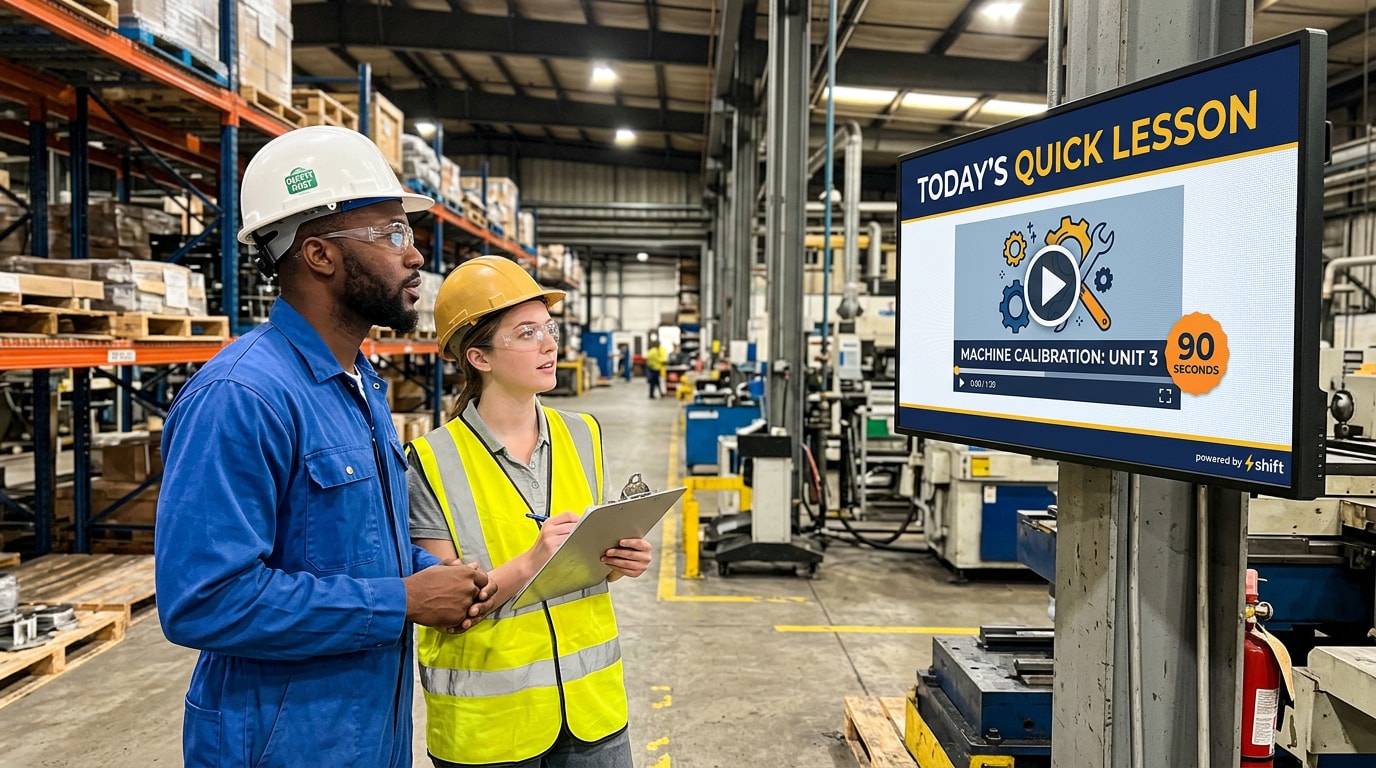
Walk into the back of house at almost any quick-service restaurant and you'll see the same scene: a laminated binder gathering grease near the prep station, a training video nobody has watched past minute three, and a new hire trying to remember fry times, register codes, and allergen protocols all in their first shift. This is the reality of training in an industry that hires constantly, moves fast, and can't afford to pull people off the floor for hour-long classroom sessions.
This environment is exactly where microlearning can offer assistance — as it’s currently reshaping how quick-service restaurants (QSR) onboard, train, and retain their workforce. Instead of thick manuals and one-time orientation sessions, screens already mounted in break rooms, kitchens, and drive-thru stations are being repurposed to deliver short, focused bursts of training content exactly when and where employees need it. For an industry defined by speed, high turnover, and constant change, this approach isn't just convenient. It may be one of the few training models that actually fits how QSR operations really work.
Want to learn how you can use digital signage to improve training and information retention? Keep reading because we’ll be discussing:
- What microlearning is
- Why it’s so helpful in the QSR industry
- How to use digital signage specifically for microlearning
- The digital signage system that can handle it all
Why Is Training Such a Problem in QSRs?
Training is important in every profession, but in QSRs especially

Before looking at the solution, it's worth understanding the scale of the training problem in QSRs. Restaurant turnover consistently ranks among the highest of any major industry, and QSR is typically the most extreme segment within it. Industry data has repeatedly shown restaurant turnover exceeding 75% annually overall, with quick-service segments often surpassing 100% and, in some reports, climbing toward 130-150%. That means many QSR locations effectively rebuild their entire staff more than once a year.
Every one of those departures triggers a new onboarding cycle, and every new hire represents real cost. Estimates for replacing a single hourly restaurant employee commonly range from roughly $2,500 to nearly $6,000 once recruiting, onboarding, lost productivity, and training time are factored in. Multiply that across dozens of locations and hundreds of employees, and training inefficiency stops being an HR inconvenience — it becomes a direct hit to the bottom line.
Traditional training methods were never built for this pace. Classroom-style onboarding, thick operations manuals, and long e-learning modules assume a stable workforce with time to sit through structured sessions. QSR doesn't have that luxury. Shifts are short, staff are often part-time or seasonal, and the person training today may be gone in a matter of weeks. Something had to change, and for a growing number of operators, that something is microlearning delivered through the digital signage already on their walls.
What Is Microlearning, and What Does It Look Like on Digital Signage?
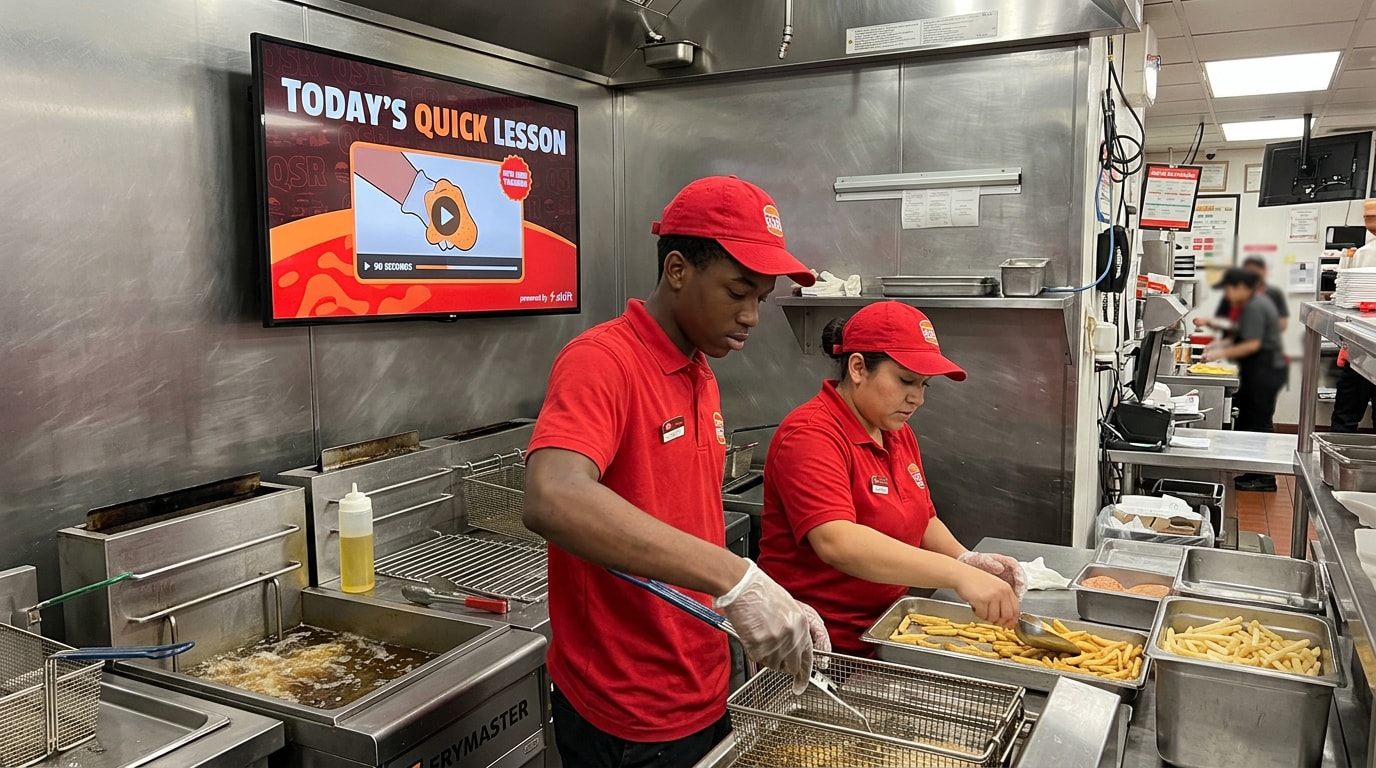
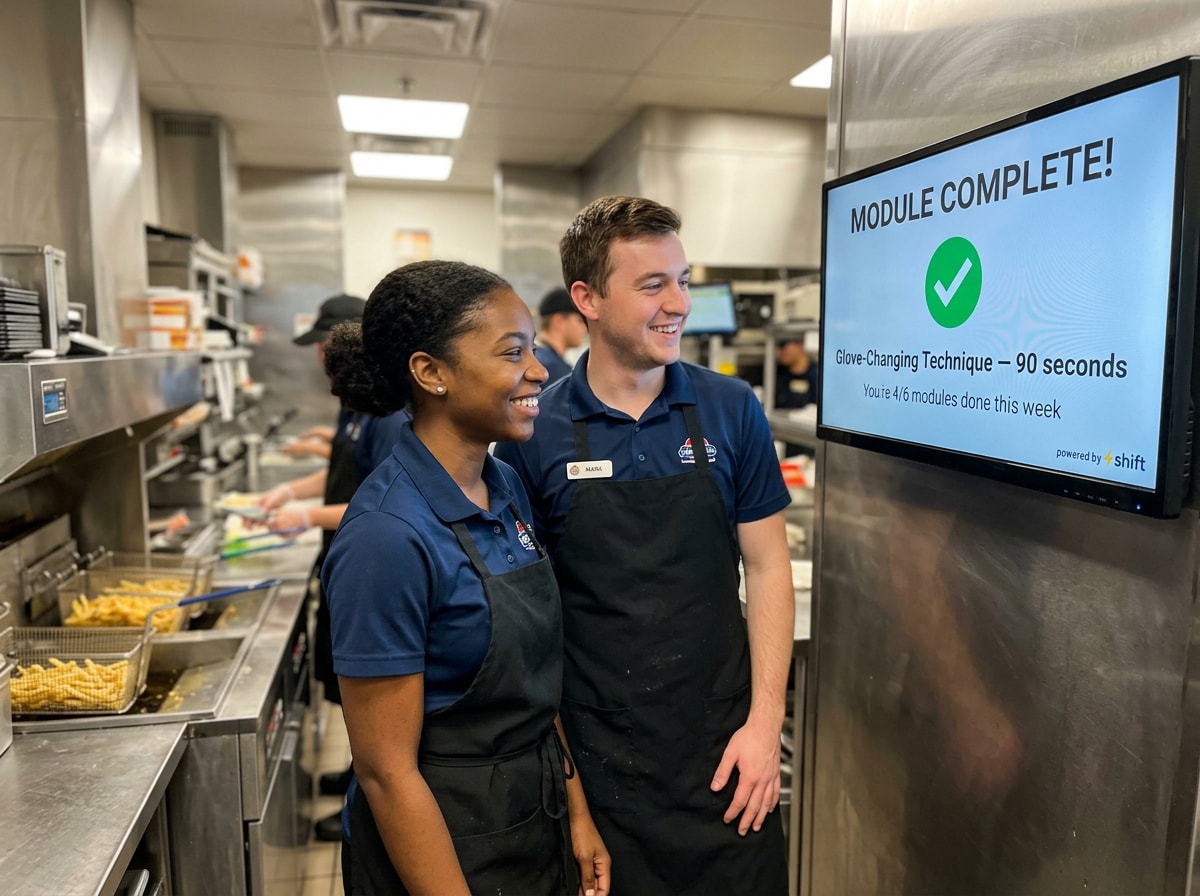
Microlearning is a training approach built around short, focused learning units — typically anywhere from 30 seconds to five minutes — each covering a single concept, skill, or task. Rather than sitting through a 45-minute onboarding video that covers food safety, register operations, customer service, and cleaning procedures all at once, an employee might instead watch a 90-second clip on proper glove-changing technique, followed later by a 60-second refresher on how to process a refund.
Digital signage turns this concept into something ambient and automatic. The same screens used for menu boards, promotional loops, or back-of-house dashboards can be scheduled to display microlearning content during off-peak hours, between shifts, or on dedicated break-room displays. A screen in the kitchen might cycle through a short animated reminder on allergen handling right before the lunch rush. A break-room screen might rotate through onboarding modules for new hires during their first two weeks, then shift to compliance refreshers once they're up to speed.
Because the content lives on infrastructure that's already installed and already part of the daily environment, there's no need for employees to log into a separate learning management system on their own device, find a quiet moment, or set aside dedicated training time. The learning happens in the flow of the workday, not apart from it.
What are the Benefits of Microlearning?
Microlearning's appeal isn't just that it's short — it's that its format aligns with how people actually retain information, especially in high-turnover, high-distraction environments.
Better retention. Learning research has long supported the idea that spaced, bite-sized instruction improves recall compared to single long sessions. Breaking training into small chunks and reinforcing it over time works with the brain's natural memory patterns rather than against them, reducing the cognitive overload that comes with trying to absorb an hour of new information at once.
Faster time to competency. New hires don't need to master an entire operations manual before their first shift. Microlearning lets them absorb just what's relevant to today's task, then build on it incrementally. This gets employees productive faster, which matters enormously when a chain is training dozens of new hires every month.
Lower training costs. Shorter modules mean less paid training time pulled away from productive work, less printed material, and less need for a dedicated trainer to walk through lengthy sessions. Content can also be updated centrally and pushed to every location at once, cutting down on the cost of retraining staff every time a menu item, promotion, or procedure changes.
Flexibility and consistency. A five-minute module can be slotted into a slow ten minutes on the floor, a break, or a shift change, without disrupting operations. And because every location is pulling from the same centrally managed content library, a new food safety standard or POS update reaches every screen in the network at once — no waiting for printed materials to be mailed out or for regional trainers to visit each site.
Higher engagement. Short-form video and interactive content mirror the media formats employees already consume outside of work. That familiarity tends to produce higher completion rates and better attention than a static slideshow or a dense PDF.
Easy measurement and iteration. Because microlearning modules are discrete and trackable, operators can see exactly which topics are being watched, skipped, or repeated — and refine the content accordingly, something far harder to do with a monolithic training video.
Why Microlearning On Digital Signage Is a Perfect Fit for the QSR Industry
There are all kinds of microlearning opportunities to put up on digital signage

These benefits matter everywhere, but they line up really well with the specific operational realities of quick-service restaurants.
High turnover demands fast, repeatable onboarding. With turnover rates that regularly exceed 100% annually in QSR, operators can't rely on a training model that takes days to complete. Microlearning modules that take minutes rather than hours mean a new hire can be trained on core tasks before their first shift ends, not after a week of shadowing.
Employees learn on the clock, in short windows. QSR shifts don't offer long stretches of downtime for structured training. What they do offer are frequent short lulls — a quiet ten minutes before the lunch rush, a few minutes during a shift changeover. Microlearning is built precisely for these windows, making it possible to train without pulling staff off the floor for extended periods.
The workforce skews young and mobile-native. A large share of QSR employees are teenagers, students, and other workers for whom short-form digital content is already the default way of consuming information. Presenting training in that same format — brief, visual, screen-based — meets employees where they already are, rather than asking them to adapt to an unfamiliar medium.
Menus, promotions, and procedures change constantly. QSR brands roll out new products, limited-time offers, and updated procedures on a near-continuous basis. A static onboarding manual goes stale almost as soon as it's printed. Digital signage-based microlearning can be updated centrally and pushed to every location instantly, keeping every crew member current without a single reprint.
Consistency matters across hundreds or thousands of locations. A quick-service brand's reputation depends on the experience being nearly identical whether a customer is in Ohio or Oregon. Centrally managed microlearning content ensures that food safety steps, brand standards, and customer service scripts are delivered the same way at every location, reducing the variability that comes from relying on individual manager-led training.
Low training cost per employee is essential to the business model. QSR operates on thin margins and high labor turnover, meaning every dollar spent on training needs to work efficiently. Because microlearning content can be reused, updated, and redeployed at near-zero marginal cost once created, it fits a cost structure that can't absorb expensive, one-off training programs for every new hire.
Compliance and food safety require constant reinforcement, not one-time coverage. Health and safety violations are a serious operational and reputational risk in food service. Rather than treating food safety training as a single onboarding checkbox, digital signage allows operators to loop short reminders and refreshers throughout the year — right before health inspections, during flu season, or after a menu change introduces a new allergen risk.
Practical QSR Considerations
Operators considering digital signage for microlearning should keep a few practical points in mind. Content needs to be genuinely short — padding a five-minute module to fill screen time defeats the purpose. Placement matters too: screens visible during natural downtime (break rooms, prep stations, back hallways) tend to outperform screens crammed into high-traffic customer-facing areas where staff have no time to engage. And because most QSR crews are multilingual, offering modules with visual-first design and simple captions, rather than dense text, helps content get absorbed regardless of an employee's first language.
Finally, microlearning through signage works best as a complement to, not a total replacement for, hands-on training. Certain skills — knife handling, equipment operation, de-escalating a difficult customer interaction — still benefit from in-person coaching. The strongest programs pair short digital modules for knowledge and procedure with brief, guided practice on the floor.
Use Shift for Microlearning on Digital Signage in the QSR Industry
If you’re ready to take the next step into training your QSR staff, then consider using Shift for all your digital signage needs. Shift is easy to set up thanks to its plug and play design that allows you to have content rolling on your screens from the start. With built-in templates perfect for engaging staff with microlearning opportunities, it’s simple to keep safety and training at the forefront of every shift in the restaurant.
In addition to microlearning opportunities, you can also use Shift for:
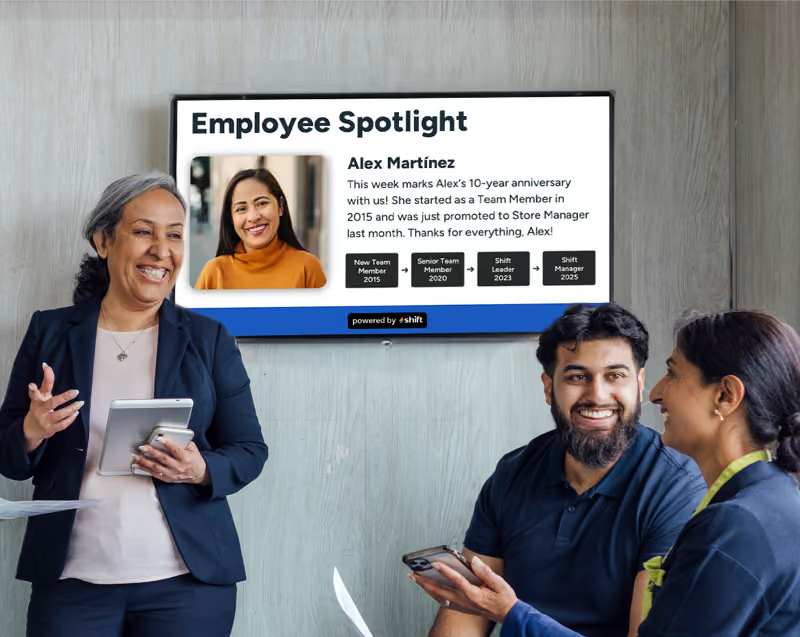
- Employee recognition through spotlights, work anniversaries, achievements, and birthdays
- Access to training materials and quick QSR refreshers
- Assisting with onboarding (for both employees and locations)
- Wayfinding
- Internal company communications specifically for QSR restaurants
- Safety information for specific stations such as knife cutting and operating fryers
- Surveys for staff through QR codes
- Real-time leaderboards and inventory lists
- Showing current promotions and discounts
- Ways to promote cross-selling and upselling opportunities to customers
Microlearning delivered through digital signage trains employees in the small windows of time they actually have, reinforces knowledge the way the brain retains it best, keeps content current across every location without added printing or travel costs, and does all of this using screens restaurants have already installed. For an industry where a new hire might be gone in six weeks and a menu might change again next month, the ability to train quickly, consistently, and continuously is essential.