The automotive industry runs on precision, speed, and heavy machinery — a combination that makes it one of the more hazardous corners of American manufacturing. From stamping presses and robotic welders on the plant floor to lifts, air tools, and hazardous fluids in the repair bay, automotive workplaces present constant opportunities for something to go wrong. Manufacturers and repair shops alike are under growing pressure to reduce incidents, cut compliance risk, and keep employees engaged with safety practices that too often become background noise.
This is exactly where digital signage for safety can help. Static posters and laminated checklists have been the default for decades, but they're easy to ignore and hard to update. Digital signage gives automotive facilities a way to make safety communication dynamic, immediate, and impossible to tune out — while giving safety managers a single platform to update messaging across every screen, in every facility, in seconds.
But why is it so important to switch to digital signage in the automotive industry, especially when it comes to safety? In this article, we’ll be covering:
- Why safety is such a critical concern in automotive manufacturing and repair work
- How digital signage helps address these concerns
- Specific types of safety content that make the biggest difference on the floor and in the shop
- The only digital signage platform you need to make a safety-first workforce
Why is Safety Such a Critical Concern in Automotive Manufacturing?
The automotive industry can be dangerous, which is why it’s crucial to repeatedly enforce safety culture
Automotive manufacturing consistently ranks among the more injury-prone sectors of U.S. industry, and the numbers explain why safety has to be a constant priority rather than an occasional initiative.
The injury rate remains above the national average. Manufacturing as a whole recorded a total recordable case rate of 2.7 injuries per 100 full-time workers in 2024, compared to 2.3 across all private industry. In 2024 alone, manufacturers reported roughly 332,600 nonfatal injury and illness cases, and the sector still accounted for hundreds of fatalities in recent years. Automotive plants, with their mix of heavy presses, robotics, conveyors, and high-speed assembly lines, sit within that risk profile.
The most common injuries are preventable. Back injuries and strains are the leading injury category in manufacturing, accounting for roughly 22% of all incidents — largely tied to repetitive motion, awkward lifting, and poor ergonomic habits. Struck-by and caught-in incidents involving machinery or equipment are also a major contributor, and getting caught in or between equipment remains disproportionately represented among the most severe and costly claims. Almost all of these are the kind of injuries that proper training, consistent reminders, and situational awareness can prevent.
New and transferred employees are especially vulnerable. Recent workers' compensation data spanning more than a million claims shows that certain injury types spike sharply among first-year employees, who are still building proficiency with equipment and processes. That's an obvious clue that onboarding, refresher training, and machine-specific instruction need to be reinforced constantly — not delivered once during orientation and forgotten.
The financial and human stakes are enormous. Workplace injuries across U.S. industry cost an estimated $181 billion or more annually, and manufacturing alone accounts for several billion dollars of that burden every year. Beyond the direct costs of medical care, workers' compensation, and lost productivity, safety incidents damage morale, increase turnover, and expose employers to OSHA citations and legal liability. On the repair shop side, the risks are just as real: lifting heavy vehicles, working with pressurized systems, handling flammable fluids, and operating power tools in tight bays all create daily opportunities for injury if attention lapses even briefly.
The common theme across all of these risk factors is communication. Machinery doesn't become safer on its own, and training definitely doesn't stick after a single session. Workers need constant, visible, easy-to-absorb reinforcement of safety practices — delivered in the moments and locations where they are actually performing their job.
How Does Digital Signage Help Reinforce Safety in the Automotive Industry?
Put essential safety information front and center and highly visible using digital signage
Digital signage transforms safety communication from a static, easily ignored formality into an active, always-current part of the daily work environment. Here's how it makes a measurable difference on the floor and in the shop.
It puts safety information exactly where and when workers need it
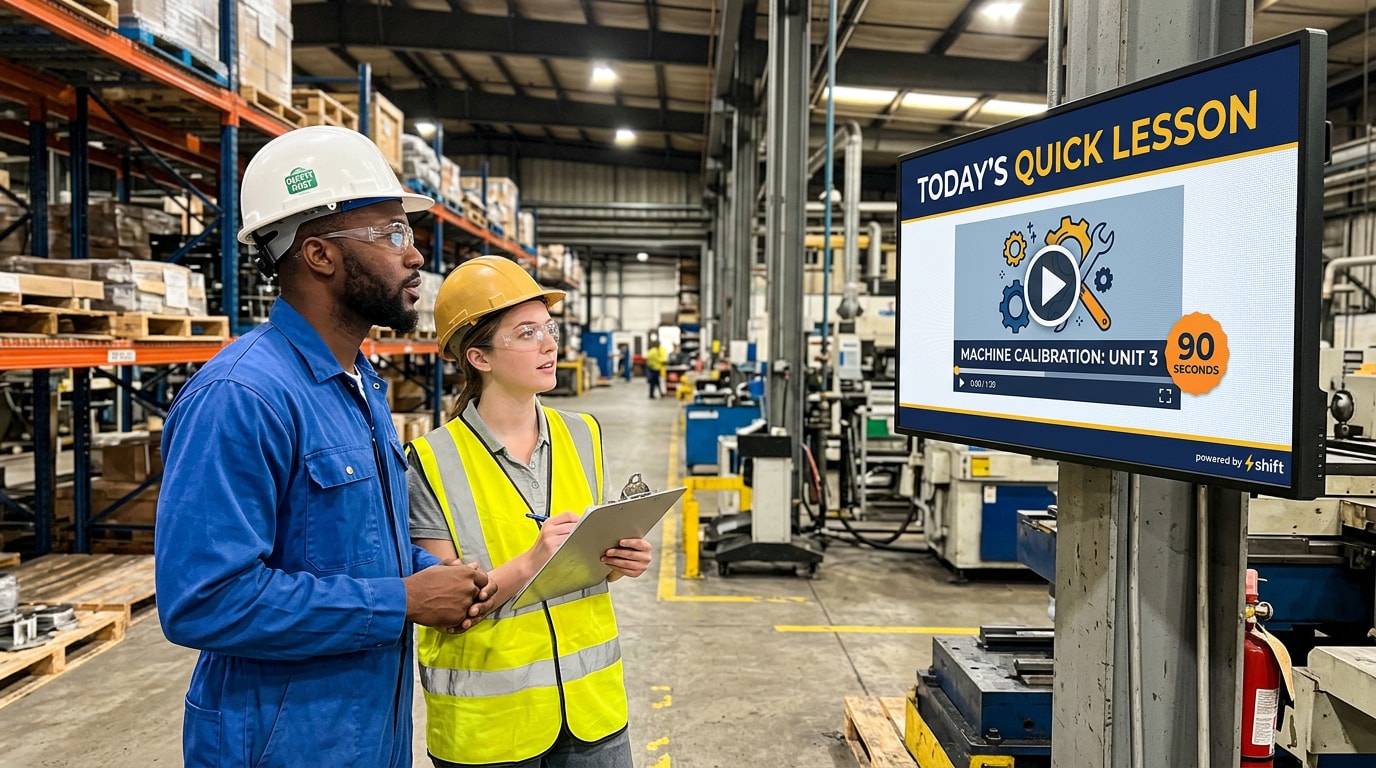
Screens can be placed at the specific points where risk is highest — next to a press, above a lift bay, at a forklift crossing, near an eyewash station — and display content relevant to that exact location. Instead of a generic poster bolted to a break room wall, workers see the reminder that matters most right where the hazard exists.
It keeps content current without the lag of print
Printed signage is a snapshot in time. Once a procedure changes, a recall is issued, or a new hazard is identified, someone has to notice the poster is outdated, design a replacement, print it, and physically swap it out — a process that can take days or weeks, during which workers are following stale instructions. Digital signage platforms let safety managers push updates to every screen, in every facility, from a single dashboard in minutes. That responsiveness matters enormously during an active recall, a chemical spill protocol change, or a new piece of equipment coming online.
It reinforces training instead of replacing it
Formal safety training happens periodically; digital signage happens constantly. Rotating reminders and micro learning opportunities about PPE requirements, lockout/tagout steps, or proper lifting technique keep training concepts fresh between formal sessions, which is especially valuable for the new and transferred employees who statistically face the highest injury risk in their first months on the job.
It supports real-time emergency communication
Beyond routine reminders, digital signage networks can integrate with fire alarms, weather alerts, or facility-wide emergency notification systems to instantly display evacuation routes, shelter-in-place instructions, or hazard alerts across every connected screen. In a fast-moving incident, that speed can be the difference between an orderly response and chaos.
It tracks and demonstrates compliance
Many digital signage platforms offer scheduling, proof-of-play reporting, and audit trails, which help safety and compliance teams document that required safety messaging was actually displayed — useful both for internal quality processes and for demonstrating due diligence to regulators like OSHA.
It engages a workforce that print doesn't reach
Motion, color, and short-form video draw attention in a way static posters can't, particularly on a noisy, visually busy shop floor. Digital signage can also support multiple languages on a rotating basis, which matters in automotive facilities with diverse, multilingual workforces — ensuring critical safety information isn't lost in translation, literally.
Together, these capabilities turn safety communication from a compliance checkbox into a living system — one that adapts as fast as the risks on the floor do.
Safety Content for Automotive Manufacturers and Repair Shops That You Can Use Right Now
Need some help getting started with your safety content? Consider these options.
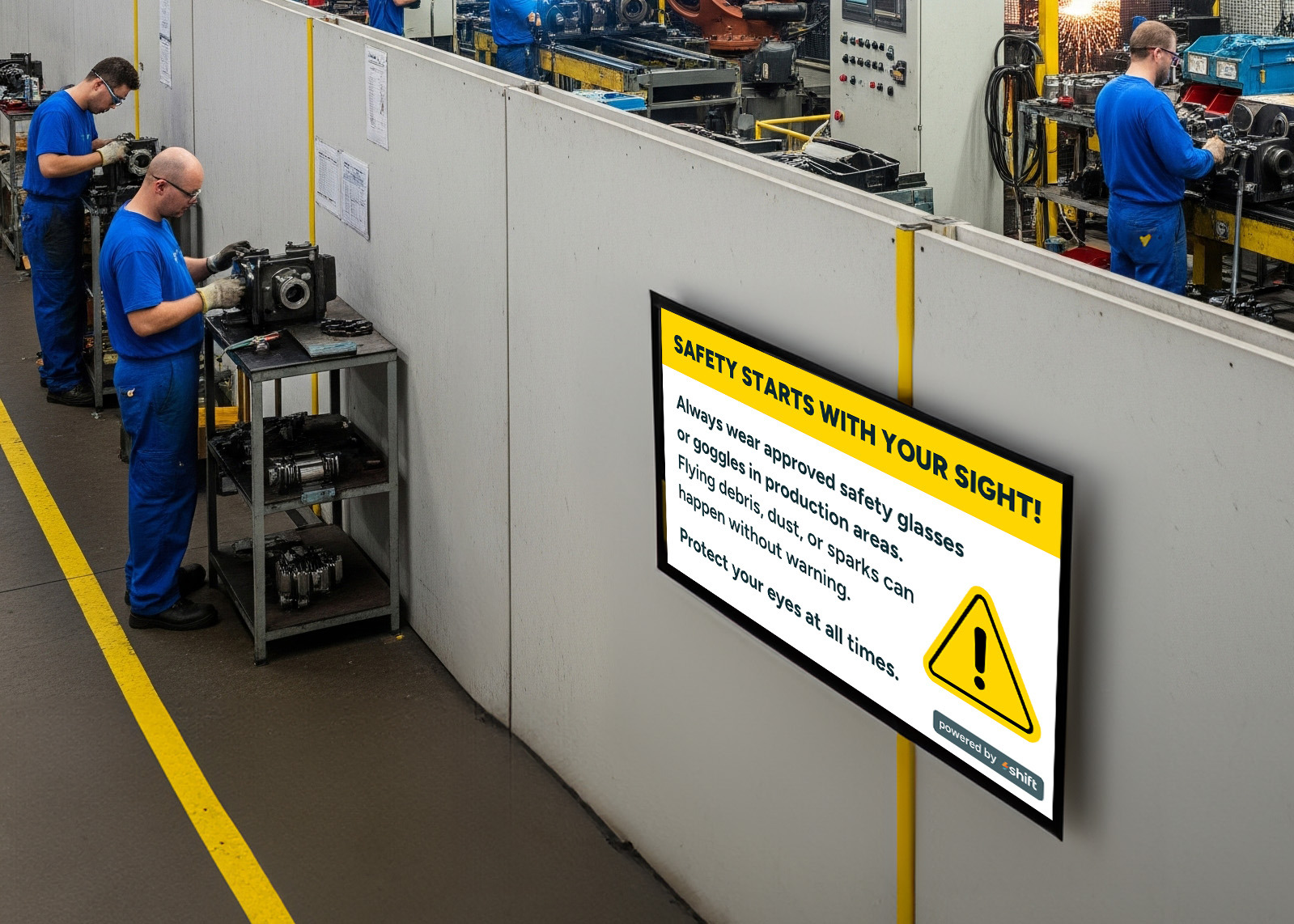
The value of digital signage depends on what's actually displayed. Below are practical categories of safety content that translate well to screens in both large-scale manufacturing plants and independent or franchise repair shops.
For automotive manufacturing plants
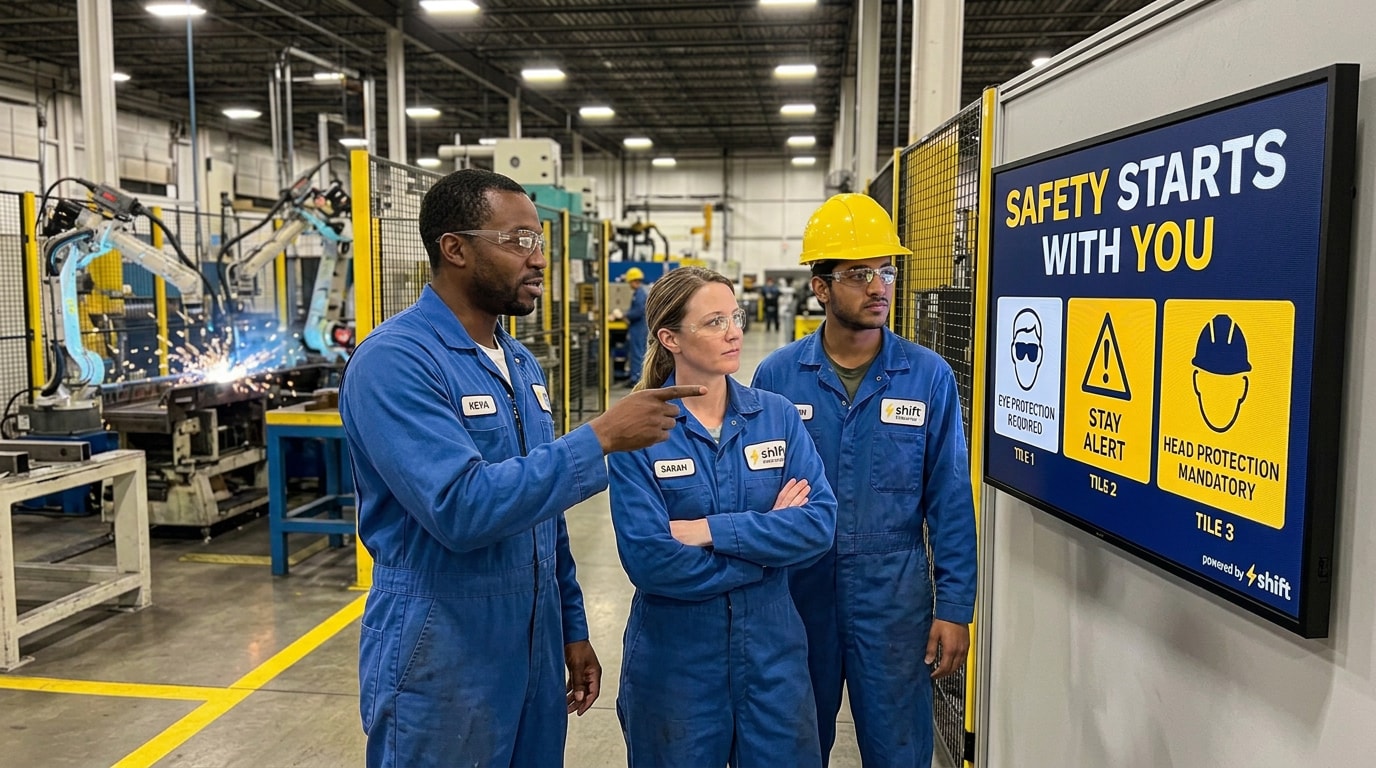
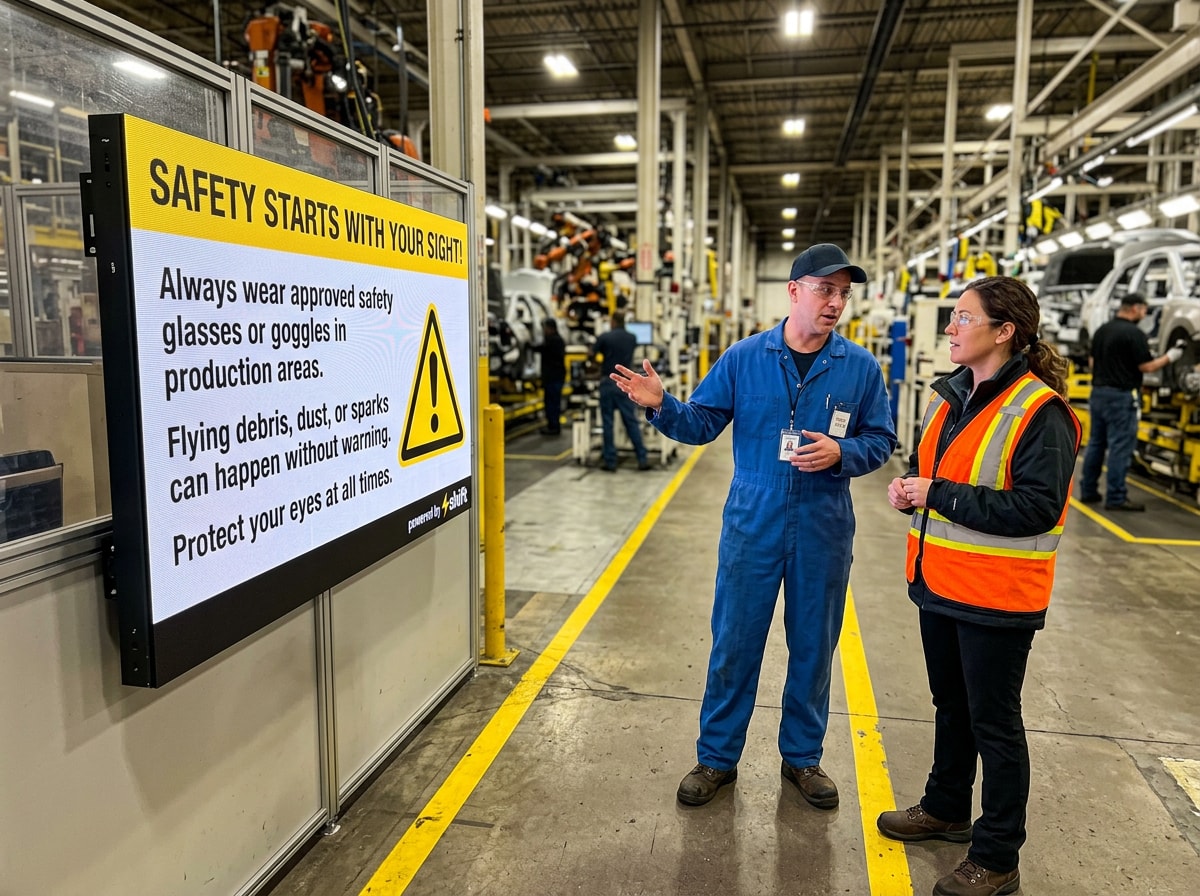
- PPE requirement reminders by zone. Screens near paint booths, welding stations, or press lines can display the specific protective equipment required in that exact area — respirators, face shields, hearing protection — rather than a generic company-wide PPE poster.
- Lockout/tagout (LOTO) procedure walkthroughs. Step-by-step visual reminders near equipment that requires energy isolation before maintenance help reinforce a procedure that, when skipped, is one of the leading causes of severe manufacturing injuries.
- Ergonomics and lifting technique reminders. Given that back injuries account for roughly a fifth of all manufacturing injuries, short animated or illustrated reminders on proper lifting form, workstation posture, and stretch breaks near high-repetition stations can meaningfully reduce strain injuries over time.
- Machine-specific hazard alerts. Robotic work cells, conveyor lines, and automated presses can have dedicated screens displaying pinch-point warnings, safe-zone boundaries, and restart procedures — critical information for new employees who haven't yet internalized the equipment's risks.
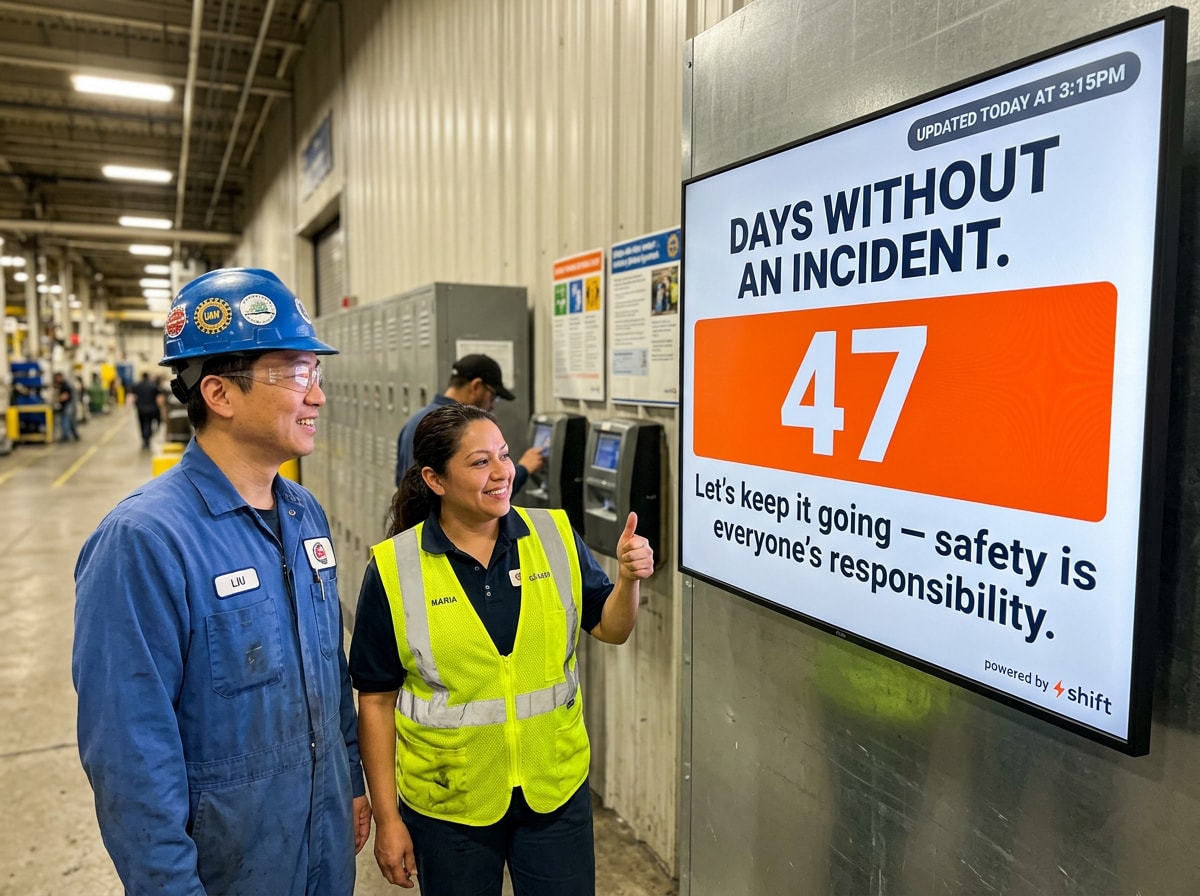
- Real-time safety metrics and recognition boards. Displaying days-since-last-incident counters, near-miss reporting reminders, or team safety recognition helps build a visible culture of accountability rather than treating safety as an abstract policy.
- Emergency evacuation maps and live alerts. Facility-specific evacuation routes, muster point locations, and integration with fire or chemical-spill alarm systems ensure workers get consistent, immediate direction during an emergency.
- New hire and contractor orientation loops. Screens in break rooms or entry points can run rotating safety orientation content aimed specifically at new or temporary workers, reinforcing onboarding material during the highest-risk early weeks on the job.
- Chemical and hazardous material handling reminders. Near paint mixing rooms or battery handling areas, signage can reinforce proper storage, spill response, and required PPE for hazardous substances.
For car repair shops
- Lift and jack safety procedures. Reminders about weight limits, proper lift point placement, and required inspection checks before raising a vehicle help prevent one of the most common sources of serious repair-shop injuries.
- Tool and equipment safety checklists. Short rotating reminders on safe use of air tools, torque wrenches, and grinders reduce the everyday risk of hand and eye injuries.
- Fluid handling and disposal guidance. Signage near fluid storage or disposal stations can reinforce proper handling of motor oil, coolant, brake fluid, and refrigerants, along with spill response steps and environmental compliance requirements.
- Fire safety and flammable material warnings. Given the presence of fuel, solvents, and battery systems, clear signage on fire extinguisher locations, flammable storage limits, and no-smoking zones is essential.
- Customer-area safety notices. Screens visible to customers in waiting areas can reinforce that certain zones are technician-only, helping prevent walk-in injuries near active bays.
- Task-specific reminders. Rotating content on hazards tied to specific repair tasks — brake dust exposure, battery acid handling, tire mounting — keeps relevant safety information in front of technicians as their daily tasks change.
- Recall and technical service bulletin alerts. For shops handling manufacturer recall work, digital signage can display current safety recall procedures and required precautions for specific makes and models, keeping technicians current without relying on printed bulletins that go stale.
Harness the Power of Digital Signage for Safety in the Automotive Industry with Shift
Safety should be front in center in an industry that is consistently dealing with higher rates of injury like automotive services. Keep it at the forefront of employees’ minds with the assistance of digital signage from Shift. You don’t have to have an IT department to get going with digital signage safety content either, thanks to the platform’s plug and play design. You can choose the type of content to cycle through each one of your display screens, ensuring safety information is regularly seen on the floor or in the shop, while other content like employee recognition and workplace surveys can be shown in the breakroom.
With Shift’s content navigator, any user can immediately update or change content from their device to reflect the most up to date information available, keeping staff safe and informed. Shift can help your business create all kinds of relevant content including:
Safety in the automotive industry isn't a single policy or a one-time training session — it's a continuous effort that has to keep pace with changing equipment, new employees, evolving regulations, and the daily realities of working around heavy machinery and hazardous materials. Digital signage doesn't replace training, PPE, or a strong safety culture — it reinforces them. By putting relevant, current, and attention-grabbing safety content exactly where workers need it, automotive manufacturers and repair shops can turn safety communication from a static formality into an active part of daily operations.