Manufacturing floors move fast, and so does the knowledge workers need to keep up with them. New equipment, updated safety protocols, evolving compliance standards, and constant process improvements mean that training can never really stop. Yet traditional training models — classroom sessions, lengthy manuals, annual certification courses — are built for a slower world. They pull workers off the line, overload them with information they won't use for months, and struggle to keep pace with the speed of change on the shop floor.
This is where microlearning, using digital signage, is changing the game. By breaking training into short, targeted bursts of content and displaying it on screens workers already pass by every day, manufacturers are finding a way to build a culture of continuous learning without disrupting production. But how can you incorporate this into the manufacturing industry?
In this article, we’ll be covering:
- What microlearning actually is
- Why it's such a strong fit for manufacturing environments
- Practical ways manufacturers are putting it to work using digital signage
- And the only digital signage platform you need to offer microlearning in the manufacturing industry
What Is Microlearning?
A helpful technique to help staff retain important information that actually works

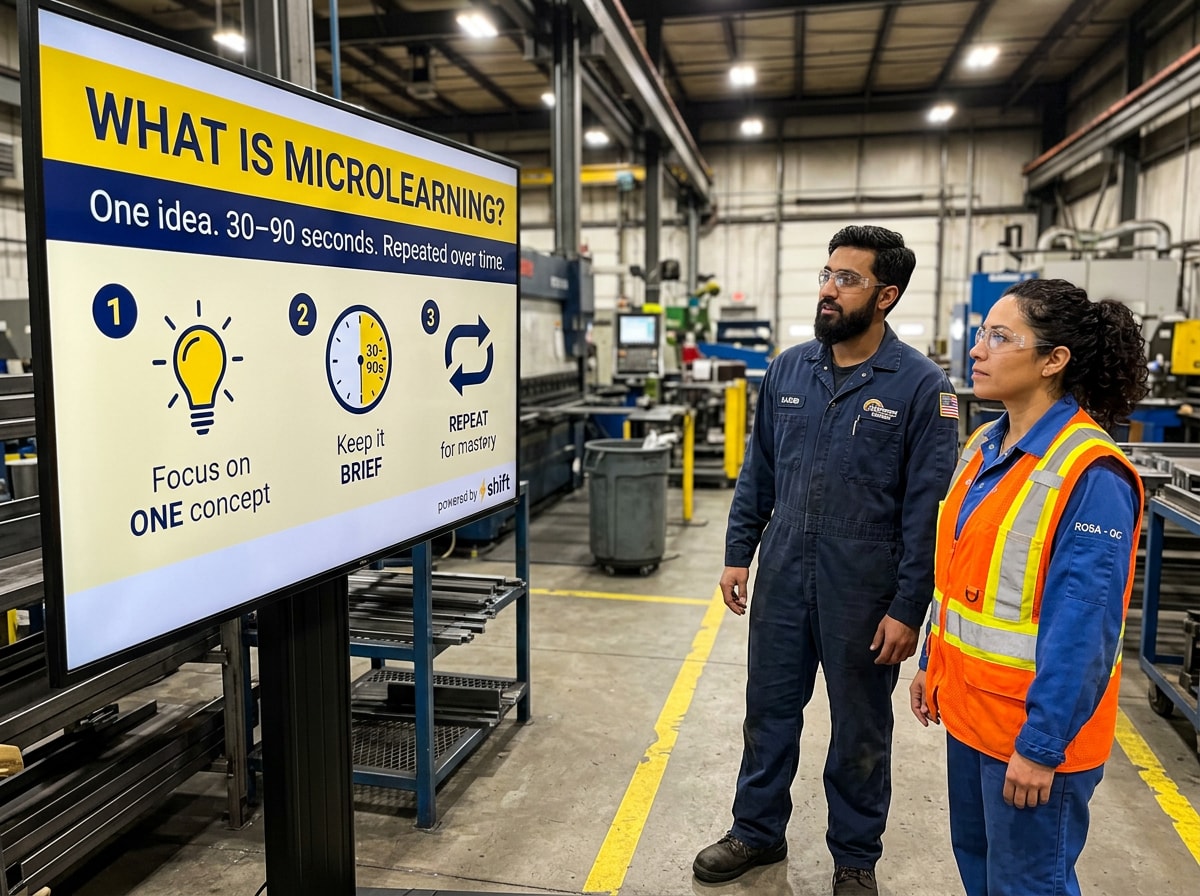
Microlearning is a training approach that delivers information in small, focused segments rather than long, comprehensive sessions. Instead of a two-hour training module covering an entire safety protocol, microlearning might break that same content into five two-minute segments, each covering a single concept, task, or reminder.
The core principles behind microlearning include:
Brevity. Each learning unit is short — typically anywhere from 30 seconds to five minutes. The goal is to convey one idea clearly rather than many ideas superficially.
Focus. Microlearning content targets a single learning objective. A microlearning segment might teach one machine setting, one safety checkpoint, or one quality control step — not an entire process from start to finish.
Repetition and reinforcement. Because the content is short, it's easy to revisit. Spaced repetition — seeing the same core message multiple times over days or weeks — helps information move from short-term to long-term memory, which is far more effective than a single long training session that's quickly forgotten.
Accessibility in the flow of work. Microlearning is designed to fit into small windows of time: a break between shifts, a pause while equipment cycles, a walk to the breakroom. It doesn't require workers to set aside a dedicated block of time away from their tasks.
Multimedia delivery. Microlearning content often uses visuals, short video clips, infographics, or simple animations rather than dense text, making it faster to process and easier to retain.
This approach is grounded in well-established learning science. Human working memory has limited capacity, and the brain retains information better when it's delivered in smaller, spaced-out doses rather than one large session — a phenomenon often referred to as the "spacing effect." Microlearning takes advantage of this by design, making it a natural match for environments where attention spans are short and time is precious.
Digital signage acts as the delivery mechanism that makes microlearning possible without adding new devices, apps, or logins to a worker's routine. Screens already installed in break rooms, near workstations, in hallways, and at entry points can be repurposed to display rotating microlearning content — turning idle moments and everyday foot traffic into easy training opportunities.
Why Can the Manufacturing Industry Benefit from Microlearning?
This safety-focused industry requires constant training in order to keep accidents at a minimum
Manufacturing is a uniquely demanding environment for training, and several industry-specific challenges make microlearning especially valuable.
1. Workers Can't Step Away from the Line for Long
Unlike office environments, where an employee might block off an afternoon for a workshop, manufacturing operations often run on tight schedules where every minute of downtime has a cost. Pulling a worker off the floor for an hour-long training session means lost productivity and potential bottlenecks elsewhere in the process. Microlearning delivers value in the small windows that are already there — shift changes, breaks, brief equipment pauses — without requiring dedicated training time that eats into output.

2. High Turnover and a Constant Influx of New Hires
The manufacturing sector has historically dealt with elevated turnover rates, along with a wave of retirements among experienced workers and a corresponding need to train newer, often younger, employees. Traditional onboarding — thick binders and long orientation sessions — struggles to keep new hires engaged and often fails to make information stick. Microlearning gives manufacturers a way to onboard efficiently, reinforcing key procedures over the first days and weeks on the job rather than trying to cram everything into day one.
3. Safety Is Non-Negotiable and Ever-Present
Manufacturing environments carry real safety risks: heavy machinery, hazardous materials, moving parts, and high-noise environments. Safety training can't be a once-a-year checkbox exercise; it needs to be reinforced constantly if it’s to be effective. Microlearning displayed on digital signage allows safety reminders, near-miss lessons, days without incident, and proper procedure demonstrations to be part of the daily visual environment, keeping safety top of mind rather than something workers only think about during annual refreshers.
4. Multilingual and Diverse Workforces
Many manufacturing facilities employ workers from a range of language backgrounds. Long, text-heavy training manuals can be a barrier for non-native speakers, while short, visual, video-based microlearning content is easier to understand regardless of language proficiency. Digital signage systems can also rotate content in multiple languages or use visual-first formats that reduce dependence on text altogether.
5. Equipment and Processes Change Frequently
Manufacturers regularly update machinery, adopt new software systems, or refine standard operating procedures to boost efficiency or meet new regulatory requirements. Static training materials become outdated quickly, and re-training an entire workforce on a new process can be slow and expensive. Microlearning content is easier to produce and update quickly — a new short video or infographic can be pushed to signage across a facility (or across multiple facilities) almost immediately, keeping training current without a major overhaul.
6. Measurable Gains in Retention and Performance
Because microlearning is grounded in how people actually retain information, manufacturers who adopt it often see tangible benefits: fewer errors, faster onboarding, improved compliance with safety protocols, and better retention of quality standards. Short, repeated exposure to key information tends to outperform one-time, lengthy sessions when it comes to what workers actually remember and apply on the job.
7. It Reinforces a Culture of Continuous Improvement
Many manufacturing operations already embrace continuous improvement philosophies like Lean or Six Sigma. Microlearning aligns naturally with this mindset — treating training not as a single event but as an ongoing process, just like the operational improvements the plant is already pursuing.
Ways to Employ Microlearning Through Digital Signage in Manufacturing
Companies have all kinds of ways to harness the power of digital signage and use microlearning to boost retention
Digital signage gives manufacturers a flexible canvas for delivering microlearning content throughout a facility. Below are practical, real-world ways manufacturers are putting this combination to work.
Break Room Safety Spotlights
Screens in break rooms and cafeterias are a natural spot for short safety reminders. A 60-second video showing correct lockout/tagout procedure, a graphic reminding workers about proper PPE for a specific task, or a quick recap of a recent near-miss and how to avoid it can run on a loop or rotate throughout the day. Because employees are relaxed and not focused on operating machinery, this is an ideal moment for information to sink in.
Shift-Change Huddle Boards
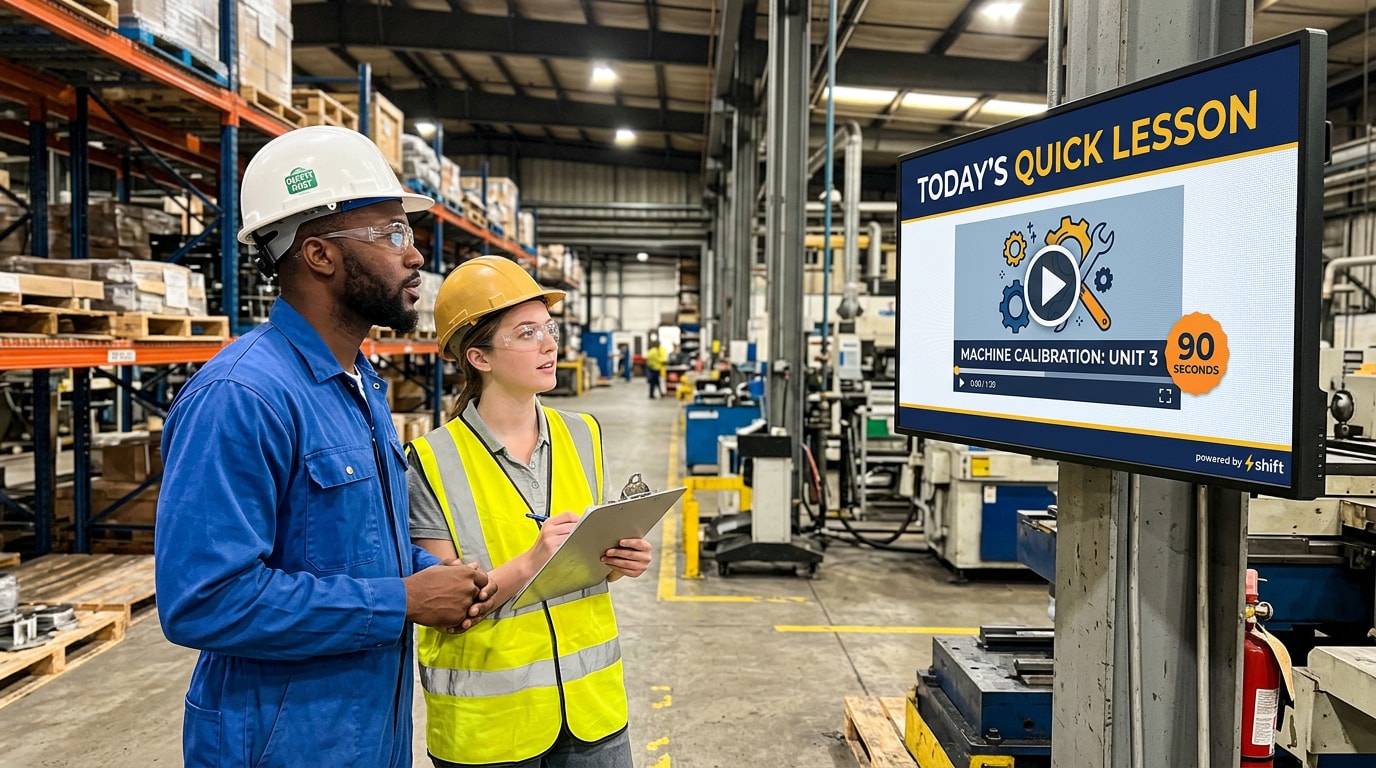
Many facilities use digital signage near time clocks or shift-change areas to display a "board" of the day's priorities: production targets, quality alerts, or a 90-second refresher video on a process that had recent issues. This turns the natural moment of a shift handoff into an opportunity for quick, relevant training tailored to what's happening on the floor that day.
Point-of-Use Equipment Reminders
Screens mounted directly near specific machines or workstations can display microlearning content relevant to that exact piece of equipment — a short animation showing the correct calibration steps, a quick visual guide to troubleshooting a common error code, or a reminder of the quality checkpoints for that station. Because the content is delivered at the point of use, it's immediately actionable and easy to connect to the task at hand.
New Hire Onboarding Loops
Rather than front-loading all training into a single orientation day, manufacturers can create a rotating onboarding series that plays across signage in common areas over a new hire's first few weeks. Each day or week introduces a new short segment — company values, a specific safety protocol, a walkthrough of a process — allowing new employees to absorb information gradually and revisit key concepts as they move through the facility.
Quality Control Micro-Demonstrations
Short video clips showing the difference between an acceptable and defective product, the correct way to perform a quality check, or common mistakes to avoid can be displayed near quality control stations or assembly lines. Visual, side-by-side comparisons are often far more effective than written specifications for helping workers quickly recognize what "good" looks like.
Compliance and Regulatory Refreshers
Rather than waiting for an annual compliance training session, manufacturers can use signage to deliver short refreshers throughout the year on topics like OSHA requirements, environmental regulations, or industry-specific certifications. Breaking a lengthy compliance document into a series of digestible visual summaries makes it far more likely that the information is retained and applied consistently.
Cross-Training and Skills Development Snippets
Digital signage can also support upskilling efforts by rotating short lessons on adjacent skills — for example, a segment introducing basic troubleshooting for a piece of equipment that a worker doesn't typically operate but might need to understand during a cross-training rotation. This supports workforce flexibility and helps prepare employees for new roles without requiring a formal classroom course.
Gamified Knowledge Checks
Some manufacturers pair microlearning content with simple interactive elements — a quick poll or quiz question displayed on signage near a kiosk, with results or leaderboards shown afterward. This adds an element of engagement and can help reinforce whether key messages are actually landing with the workforce.
Multilingual Rotations
For facilities with diverse workforces, the same microlearning segment can be programmed to rotate through multiple languages throughout the day, or displayed with universal visual cues and minimal text, ensuring that language barriers don't prevent critical information from reaching every worker.
Real-Time Alerts Paired with Learning Moments
When an issue arises on the floor — a quality deviation, a safety incident, or a process change — digital signage can be used to push out an immediate, short explanatory clip alongside the alert itself. This turns a reactive moment into a proactive learning opportunity, helping the entire team understand not just what happened, but how to prevent it going forward.
Use Shift to Power Microlearning Information in Manufacturing
If you want a digital signage platform that makes it easy to include microlearning opportunities, consider going with Shift. This all in one CMS system is designed to plug and play, with included templates and a content navigator that make creating all kinds of slides seamless. It’s simple to set up, and you can alter or push out new content from any connected device. The platform can also be connected to any internal systems of the manufacturing plant in order to have access to real-time data such as KPIs or days without an incident. Additionally, you can also use Shift for:
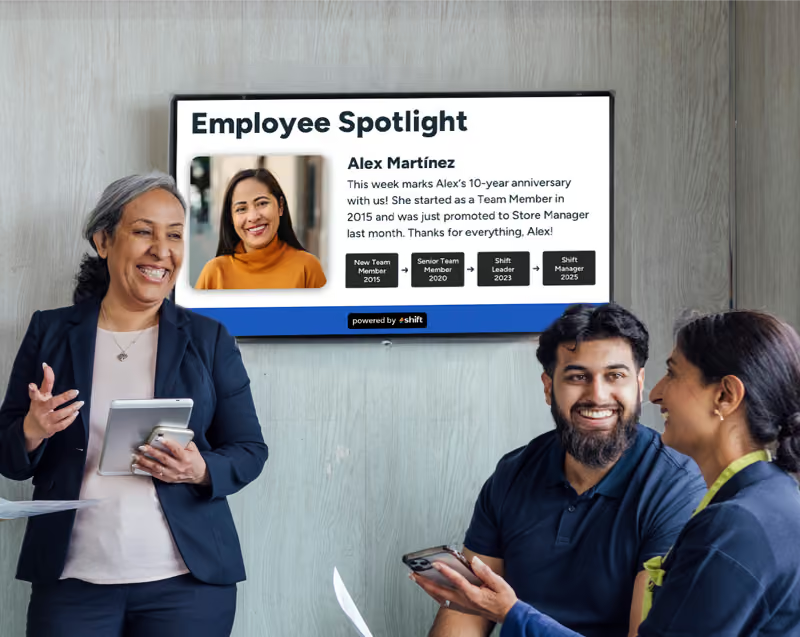
- Employee recognition through spotlights, work anniversaries, achievements, and birthdays
- Access to training materials and microlearning
- Assisting with onboarding
- Wayfinding throughout the warehouse or manufacturing floor
- Internal company communications specifically for your workforce
- Posting safety or emergency alerts
- Surveys for staff through QR codes
- Real-time information like production and performance KPIs
Microlearning succeeds because it respects two realities of the modern manufacturing environment: workers are busy, and information changes fast. Digital signage succeeds because it can be placed where staff already gather — in break rooms, at workstations, near time clocks — without demanding extra time, extra devices, or extra effort.