
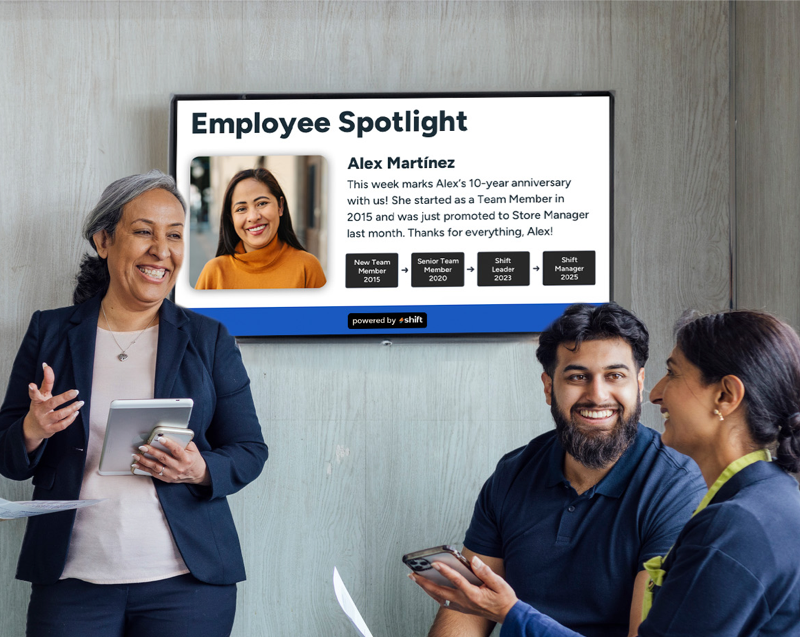

When you think of digital signage in the automotive industry, you typically think of how it benefits the showroom. Vehicle spotlights on the video wall. Financing offers on the reception screen. A loop of glowing customer reviews above the coffee machine. All of that matters — but it’s externally focused, and only covers half of the opportunity.
The other half is internal. Behind every showroom is a service department, a sales floor, a parts counter, and a back office full of people who need to stay informed, aligned, and motivated in order to deliver the experience customers actually see. Digital signage is just as capable of engaging that audience as it is of serving car buyers — and for automotive retailers juggling constant inventory changes, manufacturer updates, and shift-based staffing, it may be even more valuable there.
But what’s the best way to approach this? In this article we’ll be discussing:
- Why internal marketing deserves a real budget and strategy in the automotive industry
- The benefits of engaging in a robust internal marketing plan
- Concrete ways those in the auto industry can put digital signage to work behind the scenes
- The digital signage platform that can do it all
The Broader Benefits of a Strong Internal Marketing Strategy
Don’t overlook the advantages that an internal marketing strategy has on your staff!

Even outside the specifics of the automotive industry, a deliberate internal marketing strategy tends to pay off in a few consistent ways:
- Stronger alignment. When everyone hears the same message at the same time, teams spend less energy reconciling conflicting information and more energy executing on shared goals.
- Higher engagement and morale. Employees who feel informed and recognized tend to be more invested in their work, which shows up in day-to-day effort as much as in retention numbers.
- Faster adoption of change. New policies, tools, or initiatives roll out smoothly when there's an established channel for communicating them clearly, rather than relying on word of mouth or buried emails.
- A stronger employer brand. Just as customer-facing marketing shapes how buyers see a business, internal marketing shapes how current and prospective employees see it — and that reputation follows a company into recruiting.
- Better customer outcomes. Informed, motivated employees are simply better equipped to represent a brand well, which means internal marketing indirectly supports the same goals as external marketing.
What "Internal Marketing" Actually Means in the Automotive Industry
Internal marketing is the practice of communicating with employees the same way you'd communicate with customers: intentionally, visually, and consistently, rather than through scattered emails, memos taped to a breakroom wall, or whatever gets mentioned in a rushed morning huddle. It covers things like:
- Company news, policy updates, and manufacturer bulletins
- Sales performance, goals, and recognition
- Training and compliance content
- Safety procedures and OSHA reminders
- Culture-building: birthdays, anniversaries, wins, community involvement
For automotive companies, this isn’t a bonus, it’s an operational necessity, for a few reasons specific to the business.
Dealerships and Automotive Companies Run on Fast-Changing Information
Manufacturer incentives change monthly. Inventory turns over daily. Sales goals reset constantly, and service specials rotate with the seasons. A printed flyer or a static bulletin board can't keep pace with that rate of change, and information that's out of date is often worse than no information at all — a salesperson quoting last month's incentive to a customer is an easy way to lose trust before a deal even starts. Digital signage solves this problem by letting managers push updates to every screen instantly, from one dashboard, without reprinting anything.
The Workforce Is Distributed and Shift-Based
A typical dealership has sales staff, service advisors, technicians, parts staff, and administrative teams, often working different shifts across different buildings or bays. An auto repair shop has a similar deskless set up. A single company-wide email easily gets missed by someone who wasn't at their desk when it landed, and a message delivered only in a morning meeting never reaches the closing shift. Many automotive employees who work hands on with cars might not even have a desk, or a company email.
Screens placed in shared spaces — breakrooms, the service bay, the parts counter — reach people passively, on their own schedule, without requiring them to check an inbox.
Turnover Makes Culture and Morale a Competitive Issue
Automotive businesses have historically dealt with high turnover, particularly on the sales floor and with technicians. Recognition, transparency around goals, and a sense of momentum all help retention — and all of them are naturally suited to a screen. Seeing your name on a leaderboard, or seeing the team hit a shared monthly target, does more for morale in the moment than a message in a shared drive ever will.
Employees Shape the Customer Experience Directly
Car buying and vehicle service are both high-trust, high-stakes purchases for the customer, and the salesperson or service advisor is the face of that trust. A well-informed, motivated employee sells and services better than a distracted or confused one. Internal marketing isn't a “nice culture thing,” it's actually connected to revenue. A staff member who knows this week's incentive, this month's goal, and where the team stands relative is simply better equipped for the conversations that happen on the floor.
Concrete Ways Companies in the Auto Industry Can Use Digital Signage Internally
Looking for ways to start an internal marketing program? Check out these top content ideas

The good news is that most of this doesn't require new hardware if an automotive business already has screens for customer-facing content. The same media players and content management software driving showroom displays can run a second set of playlists in staff-only areas for internal communication, often on a completely separate schedule and screen network.
1. Real-Time Sales and Service Dashboards
Instead of a manager reciting numbers in a morning meeting, a screen in the sales bullpen or service write-up area can show live figures: units sold this month against goal, gross profit trends, service department throughput, or CSI (customer satisfaction index) scores. Because most dealership management systems (DMS) can export data, these dashboards can often pull numbers automatically rather than requiring someone to update slides by hand.
Why it works: transparency around numbers keeps everyone oriented toward the same targets, and a dashboard that updates itself removes the labor of manually re-posting stats every day.
2. Sales Leaderboards and Recognition
A rotating leaderboard showing top performers by units sold, upsells, or CSI score turns competition into something visible rather than something only a manager tracks in a spreadsheet. Pairing this with an "employee of the month," service technician spotlight, or shout-outs for training milestones adds a recognition layer that costs nothing beyond a slide template.
Why it works: public recognition is one of the least expensive, highest-impact retention tools available, and a shared screen makes it visible to the whole team at once instead of a private note.
3. Manufacturer and Product Updates
New model launches, feature changes, updated financing programs, chances to service pricing, and manufacturer certification requirements all need to reach the floor quickly and accurately. A dedicated "product knowledge" playlist in the sales breakroom — short video explainers, new trim comparisons, updated incentive sheets — keeps staff current without pulling them into a separate training session every time something changes.
Why it works: employees who are confident on product details close more effectively and build more trust with customers who often arrive having already done their own research.
4. Service Bay and Technician Communications
The service department has its own internal audience with different needs: safety reminders, recall bulletins, technician certification deadlines, parts availability, and shift schedules. A screen mounted in the technician area or parts department can rotate through this operational content, reducing the need for paper postings that go unread or go missing.
Why it works: technicians are often the hardest staff group to reach through email, since much of their day isn't spent at a computer. A screen in the bay reaches them effortlessly.
5. Onboarding and Training Loops
New hire orientation, compliance training, and process walkthroughs can be turned into short looping video content that plays in a training room or breakroom, supplementing (not replacing) formal onboarding. This is especially useful for dealership groups with locations that hire frequently and need consistent messaging across every store.
Why it works: repetition through ambient video reinforces material without requiring staff to sit through a formal session more than once.
6. Company Culture and Community Content
Not everything needs to be numbers. Screens in breakrooms and hallways can carry birthday and work-anniversary shout-outs, photos from company events, community service days, or charity drives the dealership has sponsored. This is the same instinct that drives internal newsletters, but delivered somewhere staff will actually look.
Why it works: culture content humanizes leadership and reinforces that the automotive business is more than a sales quota — which matters for retention in a historically high-turnover industry.
7. Multi-Location Consistency for Dealer Groups
For businesses running multiple locations, digital signage software gives corporate marketing and HR a single point of control to push consistent messaging — a new benefits announcement, a groupwide sales contest, a safety alert — to every location simultaneously, while still allowing individual stores to layer in their own local content like a store-specific leaderboard or shift schedule.
Why it works: consistency in messaging across locations protects brand and culture standards without requiring every store manager to build their own materials from scratch.

8. Emergency and Time-Sensitive Alerts
Signage networks are connected and centrally managed, so they can also serve as an emergency broadcast layer — a weather closure, a recall requiring immediate parts department attention, or a facility issue — pushed to every screen in seconds. This is a use case dealerships rarely plan for up front but appreciate the first time they need it.
Is It All Worth It?
Since internal marketing doesn't generate revenue directly, it can be hard to justify against other budget priorities. But the payoff shows up in measurable places: retention and turnover on the sales floor, time-to-competency for new hires, consistency of pricing and incentive information given to customers, and how quickly new initiatives get adopted across the team. Most dealerships already track sales performance and turnover — the internal signage strategy simply becomes another variable worth watching alongside them.
Use Shift for All Your Automotive Business’ Internal Marketing Needs
If you’re ready to start an internal marketing campaign that will engage staff, increase revenue, and boost retention, turn to the powerful Shift digital signage platform. With Shift you can easily have both internal and external slides for your screens, ensuring your capturing both sides of communication. It’s designed to be as simple as plug and play, so your new internal strategy can be put to work the same day.
And with templates to help you get started with content and a 60-day free trial, there’s no reason not to get started right now. Shift can handle all your internal (and external) digital screen marketing campaigns with content such as:
- Employee recognition through spotlights, work anniversaries, achievements, and birthdays
- Company news
- Access to training materials and quick refreshers
- Assisting with onboarding
- Internal company communications that reach all employees
- Posting safety or emergency alerts
- Surveys for staff through QR codes
- Real-time information like daily KPIs
- Benefits and information
- Upcoming office events like parties or volunteer days
- Manufacturer and parts updates
Internal marketing is often treated as an afterthought in automotive retail, something handled through email chains and breakroom bulletin boards while the marketing budget goes entirely toward customers. But the employees on the floor are the ones translating every external marketing message into an actual sale or service visit. That’s why it only makes sense to turn those screens towards your staff, as well as your customers.


